
 English
 Español
 Français
 中文
中文The vulnerability inherent in love has troubled human consciousness since the earliest formations of partnered existence. To bind oneself to another is to expose the architecture of one's interior world, to render permeable what was once fortified. Throughout recorded history, cultures separated by oceans and centuries have independently developed ritualistic frameworks intended to shield romantic unions from forces that threaten their coherence—jealousy, malicious intent, spiritual interference, or the simple entropy that erodes connection over time.
These practices, often dismissed as superstition by those who prefer empirical explanations for relational dissolution, represent something more fundamental than mere theatrical anxiety. They are symbolic technologies, inherited methods of asserting intentionality over chaos, of demarcating sacred space within the profane fabric of everyday existence. When we examine spells designed to protect couples, we encounter not fantasy, but the psychological imperative to establish boundaries around what is treasured.
The Historical Precedent of Shielding Intimacy
In medieval European grimoires, protection magic occupied a liminal category between defensive necessity and spiritual hygiene. The couple was understood not as two individuals but as a composite entity vulnerable to attack precisely because of its openness to mutual influence. Germanic traditions spoke of the Schutzkreis—the protective circle—drawn with salt or iron filings around the shared sleeping quarters of newlyweds. This was no metaphor. The circle functioned as a tangible threshold, a declaration that what occurred within its boundaries belonged to a separate order of reality.
Ancient Greek practices involved the invocation of Hestia, goddess of the hearth, whose flame symbolized the continuity of domestic harmony. Offerings were made at the household altar not to petition for love's arrival, but to maintain its presence against corrosive influences. The Romans employed fascinum amulets—representations of the phallus combined with lunar symbols—to ward off the mal occhio, the evil eye that could curdle affection into resentment through the concentrated gaze of envy.
In Slavic folk traditions, couples would exchange bread baked with their combined blood—a ritual of incorporation that created immunological resonance between partners. The shared substance became a metaphysical barrier, ensuring that hexes directed at one would find no purchase on the other. This was protection through unity, a magical principle that understood separation as the primary vulnerability.
The Architecture of Protective Workings
Contemporary practitioners have inherited these methodologies, though the symbolic language has evolved. The foundational structure of couple protection spells rests on three pillars: boundary establishment, energetic cleansing, and resonant reinforcement. Each addresses a distinct vector of potential harm.
Boundary establishment involves the creation of psychic perimeters. This may take physical form—a line of black salt mixed with protective herbs like rue and angelica root, laid across all thresholds of the shared dwelling. It may be visualized: a sphere of white or golden light maintained through daily meditation, imagined to encompass both partners regardless of physical proximity. The boundary functions as selective membrane, permitting beneficial influences while repelling intrusive energies.
Energetic cleansing addresses accumulated negativity. Relationships exist in social ecosystems; they absorb the projections, judgments, and unconscious hostilities of those who observe them. Weekly smoke cleansing with rosemary or juniper, passed through each room where the couple cohabits, serves to reset the atmospheric quality of the space. Some traditions recommend bathing together in water infused with hyssop and salt on the new moon, a practice that combines ritual purification with intentional intimacy.
Resonant reinforcement strengthens the couple's internal cohesion. This might involve the creation of a shared talisman—a pouch containing rose petals from flowers exchanged between partners, intertwined hair strands, a piece of paper inscribed with both names in a continuous, unbroken line. The object is charged through simultaneous visualization, held between four hands as both individuals mentally project images of their bond's endurance. It is then kept in a private, secure location, refreshed quarterly with drops of rose oil or the smoke of copal resin.
The Mirror Spell and the Principle of Reflection
Among the most potent protection workings is the mirror spell, which operates on the doctrine of reversal rather than absorption. Two small mirrors are bound face-to-face with red thread, creating a closed reflective system. Between the mirrors, a photograph of the couple is placed, along with dried basil leaves and a written petition for protection. The construction is sealed with black wax.
The magical logic here is elegant: any negative intention directed toward the relationship encounters only its own reflection, rebounding to its source without penetrating the protected core. The mirrors create an infinite recursion, a closed loop where external interference cannot gain foothold. This spell draws from the mirror magic documented in Renaissance Italy, where polished obsidian was employed to deflect the malocchio, and from West African traditions where mirrored surfaces formed part of defensive nkisi assemblages.
The mirror spell requires maintenance. Monthly, the construction should be unwrapped, the photograph examined for any signs of deterioration, the herbs refreshed if their vitality has faded. This periodic attention is not incidental to the magic—it is the magic, a structured excuse to consciously assess the health of the bond and reaffirm protective intention.
The Candle Vigil of Sustained Presence
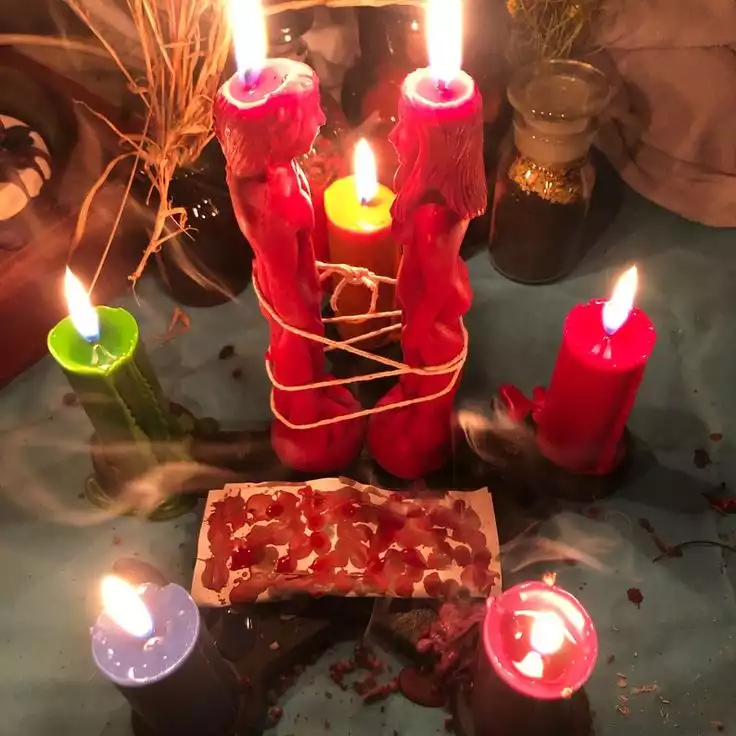
Another approach involves sustained candle magic, particularly effective for couples navigating external opposition. Two white or pink candles are anointed with protection oil—a blend of frankincense, myrrh, and vervain in olive oil base—and carved with the partners' initials. The candles are placed side by side, tied together with white cord, and positioned on a fireproof surface surrounded by a circle of salt mixed with crushed garlic and dried rue.
The candles are lit simultaneously on a Friday evening, ideally during the waxing moon. As they burn, partners maintain silent presence or speak aloud their commitment to shielding their union from interference. The ritual continues weekly for thirteen consecutive weeks, establishing a rhythmic assertion of protective will. By the final week, the candles have burned down significantly, and the accumulated wax—now infused with months of intentional focus—is collected and fashioned into a small protective charm to be kept in the bedroom.
This working addresses a particular dimension of relational vulnerability: the corrosive effect of sustained external pressure. When families disapprove, when social circles undermine, when cultural forces delegitimize a partnership, the repeated ceremonial act becomes an anchor, a weekly return to chosen ground. The magic functions psychologically as much as energetically, providing structure for resistance against erosion.
The Threshold Guardians
Doors have always held liminal significance. They mediate between public and private, between the watched self and the authentic self. In protection magic for couples, the entrance to shared space demands particular attention. The threshold becomes a site of active defense rather than passive transition.
A traditional method involves the creation of a threshold guardian—a small cloth pouch filled with protective materials and concealed above the main entrance to the dwelling. Contents typically include iron filings or nails, black salt, pieces of obsidian or black tourmaline, dried nettles, and a bay leaf inscribed with a protective symbol such as the pentacle or a bind rune combining the partners' initials.
This guardian is installed during a waning moon, when banishing energies are strongest. The person placing it recites an invocation declaring the space within as sanctified territory, impervious to jealousy, gossip, manipulation, or malicious magic. The pouch is refreshed annually, on the anniversary of the couple's union or another personally significant date.
Complementing this, some practitioners anoint door frames quarterly with consecrated oil, drawing invisible sigils of protection at the four corners of the doorway. The act transforms routine passage into conscious crossing, a daily reminder that what lies within merits safeguarding.
The Binding That Shields
Binding spells carry complex ethical considerations, but certain binding forms serve protective rather than coercive functions. A mutual binding—performed with full consent and participation of both partners—can create a unified energetic field more resistant to external disruption than either individual could maintain alone.
This ritual requires two lengths of red cord or ribbon, each approximately eighteen inches long. On a quiet evening, partners sit facing each other, each holding one cord. They speak aloud their intentions for the relationship—not romantic platitudes, but concrete commitments to mutual protection, honest communication, and sustained effort. As they speak, they braid the two cords together, creating a single twisted strand.
The completed braid is tied into a circle, forming a continuous loop without beginning or end. This loop is consecrated by passing it through incense smoke (traditionally sandalwood or frankincense) and then kept in a private location. Unlike coercive bindings that restrict individual will, this mutual binding reinforces the voluntary container within which the relationship exists, making its boundaries more defined and therefore more defensible.
The Herb Sachet of Continuous Protection
Plant allies have formed the foundation of protective magic across cultures. For couples, a carefully constructed herb sachet provides ongoing shielding with minimal active maintenance. The sachet is best assembled on a Tuesday, Mars's day, when protective and defensive energies are strongest.
Into a red or white cloth bag, combine equal parts of dried rosemary (for remembrance and fidelity), basil (for harmony), bay leaves (for protection and strength), lavender (for peace), and clove (to ward off hostility). Add a piece of smoky quartz or black tourmaline for energetic grounding and absorption of negativity. Include something personal to both partners—small photographs, paper inscribed with both names, or a object touched by both.
As each ingredient is added, state its purpose aloud. Tie the sachet closed with white string, making nine knots. With each knot, visualize a specific threat being neutralized: jealousy, betrayal, interference, dissolution, boredom, resentment, external judgment, spiritual attack, and loss of recognition. The completed sachet is placed beneath the mattress or pillow where the couple sleeps, positioning protection at the site of greatest vulnerability and intimacy.
The Practice of Continuous Attention
What distinguishes effective protection magic from theatrical gesture is the quality of sustained attention it demands. These spells are not single transactions but ongoing relationships with symbolic structures. They require periodic renewal, conscious reaffirmation, and willingness to notice when protection has weakened.
A couple serious about maintaining energetic boundaries might establish a monthly protection ritual: a designated evening when all other concerns are set aside, when the home is cleansed with smoke, when protective charms are recharged, when both partners articulate current vulnerabilities and reinforce their commitment to mutual defense. This ritualization of vigilance prevents the slow drift into complacency that often precedes relational dissolution.
The ritual calendar might include quarterly deeper workings: elaborate candle ceremonies, bath rituals, creation of new protective talismans. These punctuate ordinary time, creating temporal landmarks that measure not just the passage of months but the endurance of intentional commitment. They transform protection from abstract concept into embodied practice, from wish into continuous action.
Beyond Technique: The Philosophy of Defended Love
Underlying all protective spells for couples is a particular understanding of what love requires to survive in a world that often undermines it. These rituals acknowledge that affection alone is insufficient, that good intentions do not automatically translate into sustained connection. They recognize love as a cultivated practice rather than a spontaneous condition, something that must be actively maintained against forces of dissolution.
This perspective challenges contemporary romantic ideology, which portrays authentic love as effortless, natural, and self-sustaining. The magical tradition argues differently: love is a constructed sanctuary requiring walls, gates, and guardians. It is a territory that must be defended, not because it is weak, but because it is valuable. The very act of performing protection magic—regardless of metaphysical efficacy—constitutes an assertion that the relationship merits effort, strategy, and sustained attention.
When couples engage in protective rituals together, they participate in a form of relationship-building that mainstream therapeutic models often overlook. They create shared symbolic language, develop collaborative problem-solving approaches, and establish practices that require coordination and mutual investment. The spell becomes a container within which the relationship can develop with greater security.
Comments
No comments yet. Be the first to share your thoughts!
Leave a Comment
Your email address won't be published. Comments are reviewed before being posted.