 English
 Español
 Français
 中文
中文The inverted pentagram occupies a peculiar throne within the architecture of Western esoteric symbolism—a figure both reviled and revered, misunderstood in equal measure by its detractors and its adherents. To trace the genealogy of this enigmatic sigil is to navigate the contested terrain where sacred geometry meets cultural anxiety, where the mathematics of the divine become instruments of deliberate inversion. What emerges is not a simple tale of good turned to evil, but rather a complex narrative of symbolic reclamation, philosophical rebellion, and the enduring human impulse to mark boundaries between the sanctioned and the forbidden.
Unlike symbols whose meanings have calcified over centuries into singular interpretations, the inverted pentagram exists in perpetual dialogue with its upright counterpart, deriving much of its potency from that relationship of opposition. It is a symbol that demands to be read against something else, a mark of intentional reversal that cannot be understood in isolation from the traditions it confronts.
The Pentagram Before Its Fall
To comprehend the inverted pentagram requires first examining the sanctified history of the upright five-pointed star. The pentagram itself possesses a lineage extending into antiquity—Babylonian astronomers recognized its pattern in the celestial wanderings of Venus, tracing the planet's apparent path across the night sky over an eight-year cycle. This cosmic choreography imbued the figure with associations of cyclical return, mathematical perfection, and divine order. The Pythagoreans adopted it as an emblem of their brotherhood, finding in its construction profound truths about the golden ratio and the harmonious proportions underlying reality itself.
Medieval Christianity, inheriting these symbolic residues through Neoplatonic channels, baptized the pentagram into new service. With a single point ascending toward heaven, it became the pentalpha—a representation of Christ's five wounds, or alternatively, the five senses governed by spirit, the four elements crowned by quintessence. The symbol adorned churches, manuscripts, and talismanic objects throughout Christendom, functioning as a protective device against malevolent forces. Its geometry was understood as inherently defensive, a configuration that evil could not penetrate.
This protective function extended well beyond theological speculation into practical magic. Grimoires from the medieval and Renaissance periods consistently deploy the pentagram as a boundary marker, inscribed within circles to contain summoned spirits or worn upon the magician's person as a shield against demonic retaliation. The upright pentagram represented dominion—human will, fortified by divine authority, asserting control over the chaotic forces of the invisible world.
The inversion of such a symbol, then, could only signify catastrophe—a deliberate overthrowing of the celestial hierarchy, an intentional breach in the protective barriers separating order from chaos. Yet the story of how and why this inversion occurred reveals less about inherent evil than about the politics of symbolic interpretation and the strategic deployment of transgressive imagery.
Éliphas Lévi and the Baptism of Inversion
The formalization of the inverted pentagram as a specifically malevolent symbol emerges most clearly in the nineteenth century through the writings of Éliphas Lévi, the French occultist whose synthesis of Hermetic, Kabbalistic, and Christian mystical traditions established much of the vocabulary modern esotericism still employs. In his 1856 work "Transcendental Magic," Lévi articulated what would become the canonical distinction: the upright pentagram represents the dominion of spirit over matter, the exaltation of the higher nature, while the inverted pentagram signifies the triumph of base matter over spirit, the descent into animal nature and infernal domains.
Lévi's illustration of the "Sabbatic Goat"—better known as Baphomet—positioned within an inverted pentagram crystallized this association. The figure presents a hermaphroditic, goat-headed deity seated in a Buddha-like posture, bearing symbols of duality and integration: one arm pointing upward inscribed with "Solve," the other downward marked "Coagula," male and female attributes combined in a single form, light and darkness reconciled. The pentagram's inversion here served not merely to condemn but to encapsulate a specific philosophical proposition—that enlightenment requires descent as much as ascent, that the rejected and demonized aspects of existence possess their own sacred validity.
Lévi himself maintained an ambivalent relationship with his creation. He presented Baphomet as a symbol requiring proper understanding rather than worship, a representation of the magnum opus of alchemy wherein apparent opposites merge into unified consciousness. Yet by encoding this synthesis within the inverted pentagram, he inadvertently—or perhaps strategically—ensured the symbol's association with transgression, with the deliberate violation of established spiritual hierarchies. The image became indelible: the inverted pentagram as the sigil of forces that refuse submission to orthodoxy's gravitational pull.
What Lévi provided was not mere documentation of pre-existing symbolism but an act of creative mythography that subsequent traditions would inherit and transform according to their own philosophical requirements. The inverted pentagram, after Lévi, could never return to innocence. It had been marked, claimed, and deployed as a weapon in the perennial war between heterodoxy and established religion.
The Church of Satan and Strategic Appropriation
When Anton LaVey founded the Church of Satan in 1966, he inherited this loaded symbolic vocabulary and employed it with calculated theatrical precision. The inverted pentagram became the central emblem of LaVeyan Satanism, positioned prominently on the organization's official seal—the Sigil of Baphomet. This iteration features the inverted pentagram enclosing a goat's head, the two upward points suggesting horns, the lower three points forming a beard, with Hebrew letters spelling "Leviathan" positioned between the star's points.
LaVey's appropriation of the inverted pentagram functioned on multiple registers simultaneously. On the most superficial level, it served as pure provocation—a middle finger raised toward Christian America's moral anxieties, a deliberate embrace of the very imagery that mainstream culture had designated as supremely evil. This shock value generated publicity and attracted adherents drawn to explicit rebellion against religious conformity.
Yet beneath this theatrical gesture resided a more substantive philosophical claim. LaVey's Satanism, as articulated in "The Satanic Bible," rejected supernatural metaphysics entirely in favor of a materialist philosophy celebrating individualism, rational self-interest, and the legitimacy of earthly pleasure. The inverted pentagram, in this context, symbolized the priority of material existence over illusory spirituality, the assertion that humans are animals—sophisticated, capable of reason and creation, but animals nonetheless—and that pretending otherwise constitutes a fundamental dishonesty.
The downward-pointing configuration thus became an emblem of descending consciousness back into the body, into the earth, into the immediate and tangible rather than the deferred and transcendent. Where Christianity promised rewards in an afterlife contingent upon denial of fleshly desires, LaVey's inverted pentagram announced: this world, this body, this life constitute the only certain reality. The symbol's inversion mirrored a comprehensive inversion of values—not toward evil as traditionally conceived, but toward an alternative moral framework prioritizing vitality, pleasure, and authentic self-expression over submission and self-abnegation.
The Church of Satan's deployment of the symbol also participated in a broader countercultural moment. The late 1960s witnessed widespread questioning of inherited authorities and conventional moralities. LaVey's Satanism, and its central symbol, provided one idiom among many for articulating generational revolt. The inverted pentagram became a condensed statement of refusal—refusal to accept imposed guilt, refusal to defer gratification for hypothetical salvation, refusal to pretend that human nature aligned with the ascetic ideals of traditional religion.
Baphomet as Philosophical Synthesis
The persistent association between the inverted pentagram and Baphomet warrants deeper examination, for this coupling reveals dimensions of the symbol extending beyond simple negation or rebellion. Baphomet, as conceptualized by Lévi and subsequently adopted by various esoteric traditions, represents not merely inversion but integration—the reconciliation of apparent opposites into a coherent whole that transcends binary thinking.
The figure's hermaphroditic nature challenges rigid gender categories; its combination of human, animal, and divine attributes refuses clean taxonomic separation; its simultaneous gestures of ascent and descent suggest that spiritual evolution requires engagement with all levels of existence rather than escape from materiality. When positioned within or associated with the inverted pentagram, Baphomet transforms the symbol from mere reversal into something more complex—a glyph of deliberate paradox, of wisdom achieved through the integration of rejected knowledge.
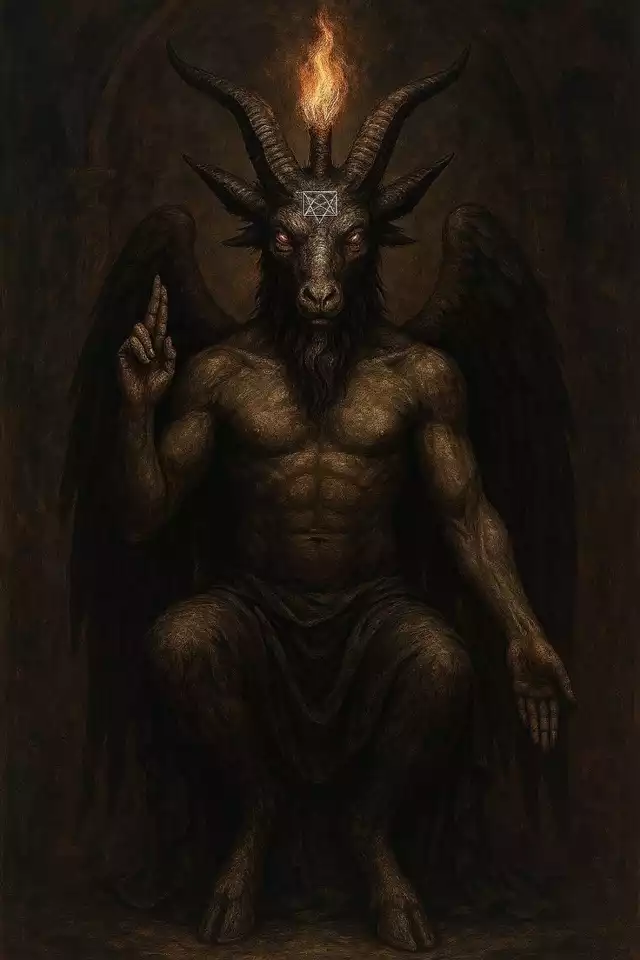
This reading finds support in alchemical traditions that predate Lévi's formalization. The alchemical maxim "as above, so below"—inscribed on Baphomet's arms as "Solve et Coagula"—proposes that microcosm and macrocosm mirror each other, that the spiritual and material realms operate according to correspondent principles. The inverted pentagram, from this perspective, does not negate the upright but completes it, forming together a dynamic polarity necessary for the Great Work of transformation.
Modern occult practitioners working within ceremonial magic frameworks sometimes employ both orientations of the pentagram with precise intentionality—the upright for invocative operations summoning higher forces or aspirational qualities, the inverted for evocative work engaging chthonic powers or exploring shadow aspects of consciousness. This pragmatic approach strips the symbol of absolute moral valence, treating it instead as a directional indicator within a broader magical grammar.
Cultural Diffusion and Moral Panic
The inverted pentagram's journey from occult treatises into broader cultural consciousness involved both organic diffusion and orchestrated moral panic. The symbol's appearance in heavy metal iconography during the 1970s and 1980s introduced it to millions who possessed no familiarity with its esoteric pedigree. Bands deployed it for its immediate visual impact and transgressive charge, often with minimal understanding of its philosophical dimensions. This popularization simultaneously increased the symbol's visibility and diluted its semantic content, transforming it into a generalized sign of rebellion whose specific references many users could not articulate.
The Satanic Panic of the 1980s seized upon such imagery as evidence of a vast conspiracy corrupting youth, conflating the inverted pentagram with genuine criminal activity despite the absence of credible evidence linking symbolic preference to harmful behavior. This moral hysteria revealed more about anxieties regarding cultural change and generational difference than about actual occult practice, yet it succeeded in cementing the symbol's association with danger in the popular imagination.
Paradoxically, this vilification enhanced the symbol's appeal for those seeking to signal alienation from mainstream values. The inverted pentagram became a badge of outsider status, adopted by subcultures defined by their opposition to conventional society. Goths, metalheads, and various countercultural movements employed it as visual shorthand for refusal to conform, often investing it with meanings largely disconnected from its occult origins.
This cultural appropriation and reappropriation demonstrates the symbol's malleability—its capacity to serve as a vessel for diverse and sometimes contradictory significances. For some, it remains primarily a religious symbol central to their philosophical identity. For others, it functions as aesthetic rebellion devoid of theological content. Still others recognize in it a historical artifact worthy of study but claim no personal investment in its meanings. The inverted pentagram thus exists simultaneously in multiple semantic registers, its interpretation dependent on context and the cultural literacy of its observers.
Geometry, Psychology, and the Architecture of Meaning
Beneath the accumulated layers of cultural interpretation, the inverted pentagram retains its geometric identity—a five-pointed star with two points ascending and one descending. This configuration possesses inherent visual properties independent of assigned meanings. The upward points create a sense of reaching, of extension toward an upper realm, while the single downward point suggests focus, concentration of force moving earthward. The shape's symmetry provides visual stability despite—or perhaps because of—its inversion of the more familiar orientation.
From a psychological perspective, the symbol's power may derive partly from its violation of expectation. The human brain excels at pattern recognition, and once the upright pentagram registers as the normative configuration, its inversion triggers immediate cognitive notice. This perceptual disruption may contribute to the symbol's effectiveness as a marker of transgression—it literally looks wrong to eyes trained by cultural conditioning to expect the alternative orientation.
Jungian analysis might interpret the inverted pentagram as an expression of the shadow archetype—those aspects of self and culture relegated to darkness and denial. By inverting a sacred symbol, practitioners potentially engage in shadow work, deliberately bringing into consciousness that which dominant culture seeks to suppress. This interpretation aligns with Baphomet's function as an integrative figure, suggesting that psychological wholeness requires acknowledgment and incorporation of rejected material rather than continued repression.
The symbol's geometric structure also invites numerological contemplation. The number five carries its own symbolic weight across traditions—five elements in Eastern philosophy, five senses, five extremities of the human body with arms and legs extended. The pentagram as a figure literally embodies human proportion, which may partly explain its persistent appearance in diverse cultural contexts. Inversion of this human figure could represent the descent into body consciousness, the recognition of humanity's animal nature, or the integration of instinctual wisdom typically subordinated to rational mind.
Contemporary Deployments and Evolving Meanings
In contemporary occult practice, the inverted pentagram functions within an increasingly sophisticated symbolic economy where practitioners self-consciously manipulate traditional imagery according to personal or organizational philosophies. The Satanic Temple, distinct from LaVey's Church of Satan, employs the inverted pentagram within a framework of political activism and religious pluralism advocacy, using the symbol's provocative charge to challenge theocratic overreach and assert minority religious rights. Here the symbol serves dual purposes—maintaining its role as marker of Satanic identity while functioning strategically within legal and political discourse.
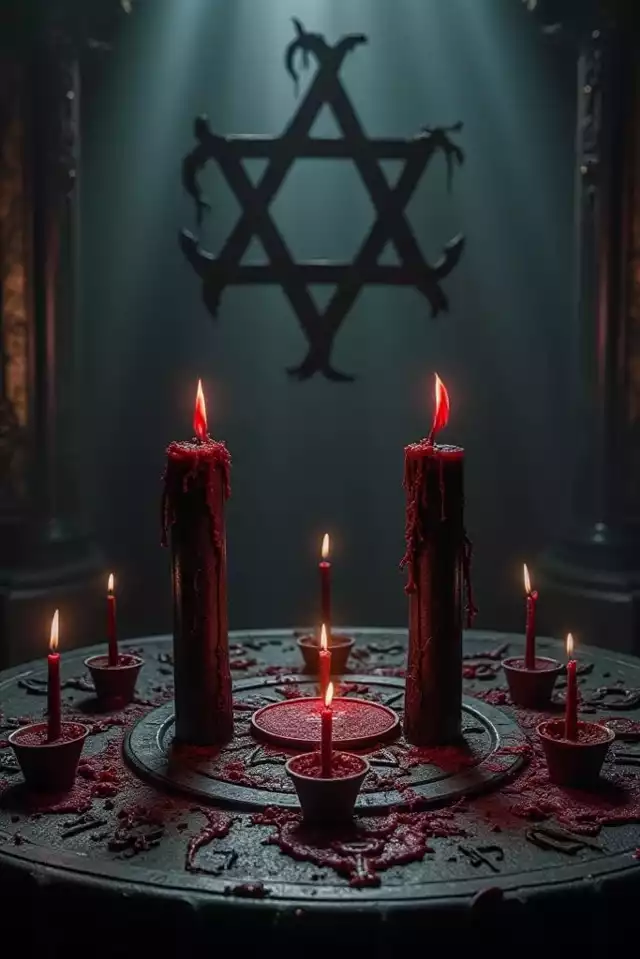
Chaos magic practitioners may deploy the inverted pentagram with deliberate irony or pragmatic instrumentalism, viewing all symbols as arbitrary constructs whose power derives entirely from the magician's invested belief rather than inherent properties. This postmodern approach treats the pentagram's orientation as strategically variable rather than fixed, potentially inverting or upright depending on operational requirements, stripping the configuration of absolute moral significance.
Neo-pagan communities exhibit varied relationships with the symbol. Some practitioners avoid it entirely due to its Satanic associations, preferring to work exclusively with upright configurations to avoid misinterpretation. Others recognize both orientations as valid, employing the inverted form in specific ritual contexts such as banishing work or shadow integration without accepting Christian frameworks that designate such operations as inherently evil. This diversity reflects broader debates within contemporary paganism regarding the relationship between modern practice and historical imagery.
The symbol's presence in popular entertainment continues to evolve. Horror films and dark fantasy literature routinely deploy the inverted pentagram as atmospheric shorthand for occult danger, often with minimal concern for accuracy regarding its actual use in esoteric traditions. This fictional representation creates a feedback loop wherein public perception of the symbol derives increasingly from entertainment media rather than religious or philosophical sources, further complicating attempts to maintain specific doctrinal meanings.
The Hermetic Mirror: Inversion as Revelation
One of the more sophisticated interpretations of the inverted pentagram emerges from Hermetic traditions emphasizing correspondence and polarity. In this view, the inverted configuration does not negate the upright but reveals its hidden complement, making explicit what the conventional orientation obscures. Just as a mirror image contains the same information presented in reverse, the inverted pentagram potentially expresses truths accessible only through deliberate reversal of perspective.
This approach finds theological resonance in Left-Hand Path philosophies that reject the conventional moral dichotomy of good versus evil in favor of more nuanced frameworks acknowledging the necessity of opposition, conflict, and transgression for growth. The inverted pentagram becomes an emblem of the sinister current—"sinister" in its original Latin sense of "left," indicating an alternative path rather than mere malevolence.
Such traditions often emphasize individual sovereignty and the rejection of external moral authorities. The inverted pentagram, in this context, symbolizes the practitioner's refusal to accept imposed hierarchies of value, the insistence on personally determining truth through direct experience rather than accepting inherited dogma. This philosophical stance aligns more with certain strains of existentialism and Nietzschean ethics than with conventional religious thought, suggesting that the symbol's significance extends beyond specifically occult discourse into broader philosophical territory.
The Hermetic principle that true wisdom requires knowledge of both light and darkness finds expression in the pentagram's dual configurations. An initiate familiar only with the upright form possesses incomplete knowledge; comprehensive understanding demands engagement with the inverted as well. This pedagogical approach treats symbolic inversion as a technology for accessing suppressed or forbidden knowledge, using deliberate transgression as an initiatory tool.
The Persistence of the Forbidden
The inverted pentagram endures as a potent symbol precisely because it encapsulates anxieties and aspirations central to Western culture's troubled relationship with its own shadows. It marks the boundary where the sacred tips into the profane, where order confronts chaos, where the official narrative encounters its repressed alternatives. Such boundary markers never lose their charge because the tensions they represent remain unresolved within the collective psyche.
Christianity's historical strategy of demonizing pre-existing pagan symbols and deities created a reservoir of rejected imagery available for later reclamation by those seeking to challenge Christian hegemony. The inverted pentagram participates in this larger pattern of symbolic warfare wherein groups contest meaning and authority through the manipulation of visual codes. Each deployment of the symbol—whether by earnest Satanists, provocative artists, or sensationalist media—contributes to an ongoing negotiation over who possesses the right to determine cultural values.
The symbol's continued capacity to shock reveals the persistence of certain taboos even in ostensibly secular contexts. Despite declining church attendance and religious affiliation in many Western nations, the inverted pentagram retains its ability to provoke visceral reactions suggesting that the cultural conditioning it indexes operates at levels deeper than conscious belief. This enduring charge indicates that the symbol touches archetypal structures of human consciousness—formations that transcend specific cultural iterations while manifesting through them.
Future developments may see continued evolution in the symbol's deployment and interpretation. As occult literacy increases through internet accessibility and the normalization of alternative spiritualities, more individuals encounter the inverted pentagram alongside explanatory context regarding its varied uses and meanings. This educational diffusion potentially diminishes the symbol's shock value while increasing appreciation for its philosophical complexity. Alternatively, cultural reaction against perceived occult influence might reinvigorate efforts to suppress or stigmatize such imagery, repeating cycles of condemnation and reclamation that have characterized the symbol's history.
Conclusion: The Geometry of Transgression
The inverted pentagram stands as testimony to humanity's enduring fascination with symbols that encode forbidden knowledge and challenge dominant paradigms. Its journey from protective talisman to emblem of spiritual rebellion illustrates the instability of symbolic meaning, the ways interpretation shifts across contexts and communities. What remains constant is the symbol's function as a marker of boundaries deliberately crossed, of hierarchies intentionally inverted, of perspectives refusing conventional framing.
To study the inverted pentagram is to confront questions extending far beyond the symbol itself—questions about authority and autonomy, about the nature of evil and the legitimacy of transgression, about whether spiritual evolution requires descent as much as ascent. These inquiries possess no final answers, only successive approximations shaped by cultural moment and individual disposition. The symbol persists because the questions it provokes remain vital, troubling, and generative of the very philosophical tensions that drive cultural evolution.
In the end, the inverted pentagram signifies what its viewer brings to the encounter—a mirror reflecting assumptions about order and chaos, control and liberation, the sacred and the profane. Its power lies not in any intrinsic property but in its capacity to catalyze these reflections, to serve as a geometric key unlocking chambers of consciousness that conventional symbols leave sealed. Whether embraced as a statement of philosophical conviction or rejected as a dangerous mark of spiritual corruption, it continues to occupy its peculiar throne—inverted, insistent, and inexhaustible in its provocations.
Comments
No comments yet. Be the first to share your thoughts!
Leave a Comment
Your email address won't be published. Comments are reviewed before being posted.