 English
 Español
 Français
 中文
中文The history of Kabbalistic magic is not the history of a tradition cleanly separated from theology, philosophy, or mysticism. It is rather the story of a particular moment—repeated across centuries—when practitioners believed that knowledge of divine names, numerical correspondences, and linguistic structures could become operative. That the structure of reality itself might be malleable through precise ritual engagement with Hebrew letters and cosmic architecture. This was never mere symbolism. It was technology dressed in sanctity, an attempt to navigate the space between prayer and power.
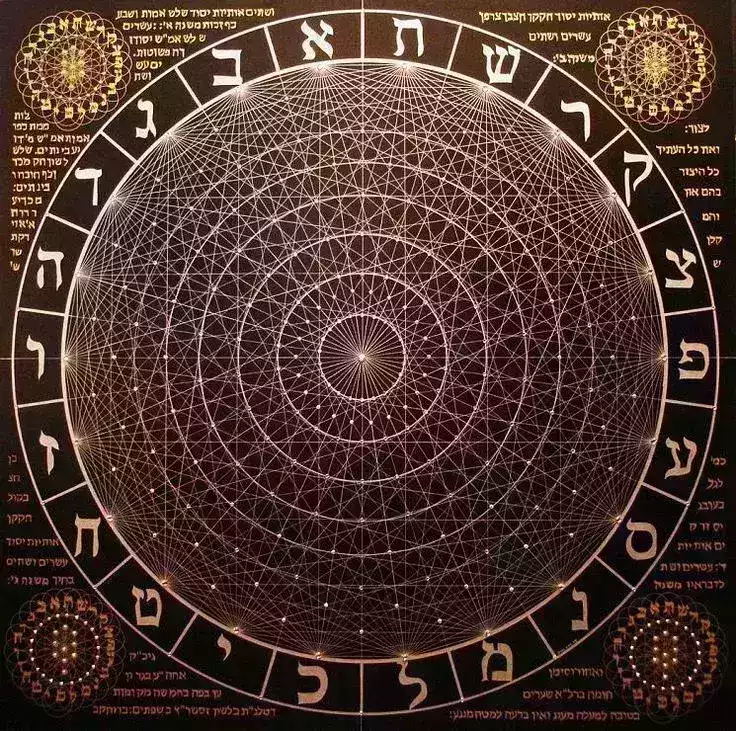
What we today call Kabbalistic magic coalesced during a specific cultural crucible: the medieval Jewish communities of Provence and Spain, where Neoplatonic philosophy, Gnostic remnants, and rabbinic scholarship collided in productive tension. The Sefer Yetzirah, or Book of Formation, composed sometime between the third and sixth centuries, provided the grammatical substrate. Its cryptic verses described how the twenty-two letters of the Hebrew alphabet and ten primal numbers—the sefirot—constituted the building blocks of creation. But it was in twelfth-century southern France that contemplative exegesis began hardening into practical technique.
The Provençal Threshold
The scholars of Provence occupied a peculiar position, geographically and intellectually wedged between Islamic Spain's sophisticated philosophical culture and Christian Europe's scholastic revival. Abraham ben David of Posquières and his circle engaged with texts that proposed not merely understanding God's creative process but replicating it through meditative manipulation of divine names. The early Kabbalists were not magicians in any vulgar sense; they were exegetes who discovered that their hermeneutic tools—gematria, notarikon, temurah—could generate not only meaning but effect.
The critical shift occurred when linguistic analysis transformed into theurgic practice. If the Hebrew language was indeed the medium through which God spoke the universe into being, then mastery over that language implied potential participation in ongoing creation. The Bahir, emerging in this milieu around 1180, introduced the sefirot as dynamic emanations—channels through which divine energy flowed into material reality. Understanding these channels suggested the possibility of influencing them.
Spanish Synthesis and the Zohar
By the thirteenth century, the focus had migrated to Castile and Catalonia, where the Kabbalistic project achieved its most influential articulation in the Zohar, attributed to the circle around Moses de León. This vast mystical commentary on the Torah presented a cosmos structured by correspondence and sympathy, where earthly actions resonated through celestial hierarchies. Though primarily devotional in intent, the Zohar provided extensive instruction on kavvanot—focused intentions accompanying prayers—that functioned as precise adjustments to cosmic machinery.
The practical dimensions remained largely implicit, encoded within exegetical passages that described angelic names, permutations of the Tetragrammaton, and the spiritual anatomy of Adam Kadmon, the primordial human. These were not spells in any conventional sense but blueprints for consciousness that, when correctly deployed, aligned the practitioner with metaphysical currents. The distinction between mystical contemplation and magical operation had become deliberately ambiguous.
Certain texts pushed further into explicitly operative territory. The Sefer Raziel HaMalakh, compiled in the thirteenth century but incorporating much earlier material, collected angel invocations, amulet designs, and ritualized permutations of divine names. Here the boundary dissolved entirely: knowing the true name of an angel meant possessing leverage over the forces that angel governed. The cosmos was legible, and legibility implied actionability.
Renaissance Dissemination and Christian Appropriation
The expulsion of Jews from Spain in 1492 scattered Kabbalistic knowledge across the Mediterranean and into Christian Europe, where it found unexpectedly receptive audiences. Giovanni Pico della Mirandola's encounter with Kabbalistic texts in the 1480s inaugurated a parallel tradition: Christian Cabala, which reinterpreted Jewish mystical doctrines through Christological lenses. What Jewish Kabbalists approached as covenant-bound practice, Christian scholars reimagined as universal metaphysics accessible to the learned regardless of religious identity.
This appropriation had profound consequences. Johannes Reuchlin's De Arte Cabalistica (1517) and Heinrich Cornelius Agrippa's De Occulta Philosophia (1533) synthesized Kabbalistic angel magic with Hermetic and Neoplatonic frameworks, creating a syncretic system that dominated European esotericism for centuries. In these hands, Kabbalah became explicitly magical—less about mystical union with the divine than about practical techniques for divination, spirit conjuration, and material influence.
Agrippa's systematization was particularly influential. His three-part structure—natural magic, celestial magic, and ceremonial magic—incorporated Kabbalistic correspondences at every level. The Hebrew alphabet became a universal key, with each letter corresponding to planets, angels, and divine attributes. Amulets inscribed with letter combinations were understood not as superstition but as precise technologies, tuning the wearer's subtle body to beneficial cosmic frequencies.
Lurianic Revolution and Practical Mysticism
While Christian Cabalists developed increasingly elaborate ceremonial frameworks, sixteenth-century Safed witnessed a parallel intensification within Jewish mysticism. Isaac Luria's radical cosmology—describing creation as a catastrophic rupture requiring human participation in cosmic repair—intensified the theurgic dimension of Kabbalistic practice. Though Luria himself apparently discouraged explicit magic, his doctrine of tikkun (rectification) implied that correctly performed rituals and prayers had genuine metaphysical efficacy.
Lurianic Kabbalah spread rapidly, and with it came an explosion of practical applications. The kavvanot became more elaborate, prescribing exact visualizations and letter permutations to accompany each blessing and commandment. Amulets incorporating Lurianic symbolism proliferated. The line between mystical devotion and magical technique had become impossible to maintain. Every ritual act was simultaneously prayer, meditation, and cosmic engineering.
This practical intensification provoked inevitable controversies. Rabbinic authorities worried that popularized Kabbalah would degenerate into superstition or, worse, provide tools for charlatans and false messiahs. The Sabbatean movement—following the messianic claims and eventual apostasy of Sabbatai Zevi in the 1660s—seemed to confirm these fears. Yet Kabbalistic practice continued to proliferate, embedded within both elite mystical circles and popular pietistic movements like Hasidism.
Modern Revival and Occult Integration
The nineteenth century witnessed Kabbalah's third major migration, this time into the burgeoning occult revival of Western Europe and America. The Hermetic Order of the Golden Dawn, founded in 1888, constructed an elaborate ceremonial system that placed Kabbalistic symbolism at its structural center. The Tree of Life became a universal diagram, mapping psychological states, tarot cards, astrological forces, and pathworking meditations onto a single coherent framework.
This was Kabbalah thoroughly abstracted from its Jewish theological context, transformed into a universal symbolic language. Practitioners like S.L. MacGregor Mathers and Aleister Crowley treated the sefirot not as emanations of the Jewish God but as archetypal principles accessible through trained consciousness. The Hebrew letters became less about divine language than about unlocking psychological and energetic potentials within the practitioner.
Yet something essential persisted: the conviction that reality possessed hidden structures accessible through disciplined symbolic engagement. Whether invoked within Orthodox Jewish prayer, Renaissance angel magic, or twentieth-century ceremonial ritual, Kabbalistic magic retained its fundamental premise—that the universe operates according to linguistic and numerical principles, and that human consciousness, properly trained, can interface with those principles operatively.
Theoretical Foundations: Language as Ontology
What distinguishes Kabbalistic magic from other esoteric traditions is its linguistic foundation. The Hebrew alphabet is not merely a conventional writing system but the actual substrate of creation. Each letter represents a primal force, a specific frequency of divine creative energy. This is not metaphor but ontological claim: the letters precede and generate material reality.
The implications are profound. If language structures being, then linguistic manipulation—through gematria, letter permutation, or careful pronunciation of divine names—becomes a genuine creative act. The magician does not merely invoke external forces but participates directly in the ongoing process of creation. The distinction between word and world collapses; speech becomes deed in the most literal sense.
This explains the tradition's obsession with precision. A single mispronounced letter could derail an entire operation not because of arbitrary rules but because accuracy was ontologically necessary. You were not reciting sounds but generating specific reality-structures. The stakes were correspondingly high: texts warned that improper use of divine names could literally unmake the practitioner.
Psychological Dimensions and Inner Work
Modern interpreters, particularly those influenced by depth psychology, have reframed Kabbalistic magic as primarily psychological technology. The sefirot map not cosmic emanations but states of consciousness; pathworking represents not astral travel but integration of psychological complexes. This reading, while perhaps reductive, captures something genuine: Kabbalistic practice always involved systematic transformation of the practitioner's awareness.
The elaborate visualizations, the hours spent contemplating letter-forms, the disciplined attention required for correct pronunciation—these constitute a training regimen for consciousness itself. Whether the angels conjured are autonomous entities or archetypal structures within the psyche may be less important than the developmental process undertaken. The magic works not despite its difficulty but because of it; the transformation occurs in the practitioner through the work itself.
This psychological dimension explains Kabbalah's enduring relevance. Even for those skeptical of its metaphysical claims, the system offers a sophisticated map of human consciousness and a methodology for its deliberate restructuring. The Tree of Life becomes a diagnostic tool, the rituals become contemplative practices, the divine names become mantras for focusing awareness. The technology remains operative regardless of belief.
Contemporary Currents and Cultural Legacy
Today, Kabbalistic magic exists in multiple simultaneous forms. Orthodox and Hasidic communities maintain traditional practices, guarding certain techniques as restricted knowledge while incorporating others into popular piety. Occult lodges continue elaborating the Golden Dawn synthesis, developing increasingly complex ceremonial systems. New Age practitioners have simplified and commodified elements, stripping away difficulty in pursuit of accessibility.
Each version preserves different aspects of the tradition. The Orthodox maintain theological seriousness and communal context; the occultists preserve technical sophistication and initiatory structure; the popularizers emphasize personal empowerment and psychological application. None fully captures what Kabbalistic magic was in its medieval or Renaissance contexts, yet collectively they demonstrate its remarkable adaptability.
What persists across all versions is the central intuition: that reality possesses hidden coherence, that consciousness can be trained to perceive and manipulate that coherence, and that language—properly understood and deployed—provides the interface. Whether one approaches this as theology, psychology, or metaphysics, the practice remains essentially unchanged: disciplined engagement with symbol, sound, and intention as a method for transforming both self and circumstance.
The history of Kabbalistic magic, then, is not the history of delusion gradually corrected by rationality, nor of perennial wisdom corrupted by superstition. It is the history of a particular metaphysical wager: that meaning and being are structurally identical, that the patterns we discover in language correspond to patterns woven into reality's fabric, and that human consciousness, through disciplined practice, can learn to read and rewrite those patterns. Whether this wager is ultimately vindicated matters less than recognizing its generative power—the extraordinary cultural, philosophical, and spiritual traditions it has produced across eight centuries of continuous elaboration.
Meta Description: Explore the sophisticated history of Kabbalistic magic from medieval Jewish mysticism through Renaissance synthesis to modern occult practice, revealing how sacred language became operative technology.
SEO Tags: Kabbalistic magic history, Tree of Life mysticism, Hebrew letter magic, Sefer Yetzirah, Zohar practical Kabbalah, Christian Cabala Renaissance, Golden Dawn Kabbalah, Lurianic theurgy, divine names magic, Jewish mysticism practice
Comments
No comments yet. Be the first to share your thoughts!
Leave a Comment
Your email address won't be published. Comments are reviewed before being posted.