
 English
 Español
 Français
 中文
中文Desire has always been an architecture. In Ancient Egypt, it was built not with supplication alone but with ritual precision—with oils pressed from sacred flowers, words incised on papyrus, and invocations spoken into the velvet quiet of temple sanctuaries. Love magic in ancient Egypt was neither whimsy nor rebellion. It was woven into the fabric of daily life, religion, and cosmic order. To shape affection, to summon beauty, to bend another's will toward longing—these were understood as participations in the generative power of the universe itself.
The ancient Egyptians did not distinguish magic from religion as modernity does. What we might call a love spell was, to them, a prayer reinforced by action, a sacred technology that harnessed divine language and material symbols to alter reality. Egyptian magic—known as heka—was considered a primordial force, one that predated even the gods. It was the mechanism through which creation unfolded, the energy that turned intention into form.
The Sacred Authority of Language and Ritual
In the temples of Thebes, Memphis, and Dendera, priests and priestesses understood that words were not merely descriptive—they were creative. The Egyptians believed that to speak a thing was to call it into being. This philosophy permeated their approach to love magic. A spoken incantation, when delivered with proper authority and ritual purity, did not ask the gods for favor. It commanded reality itself to shift.
Ritual practitioners—whether temple-affiliated priests or village healers—possessed knowledge of divine names, sacred formulas, and the proper alignment of symbolic elements. These were not trivial entertainments. They were techniques of spiritual engineering. To invoke Hathor, goddess of beauty, love, and intoxication, was to summon her presence into the ritual space, to become a channel for her seductive power. To call upon Isis, the great enchantress who reassembled her dismembered husband and breathed life back into him, was to access the most potent form of restorative and binding magic known to Egyptian cosmology.
Attraction rituals often began at dusk. Nighttime, liminal and mysterious, was considered the ideal threshold for magic concerned with intimacy and hidden desires. The aesthetics of these ceremonies were deliberate: gold vessels filled with perfumed oils, lotus flowers floating in sacred water, mirrors polished to reflect candlelight, incense curling upward in spirals of myrrh and frankincense. The sensory richness was not ornamental—it was operational. Beauty itself was a form of power, and the ritual space was constructed to embody it.
Hathor and the Cult of Seduction
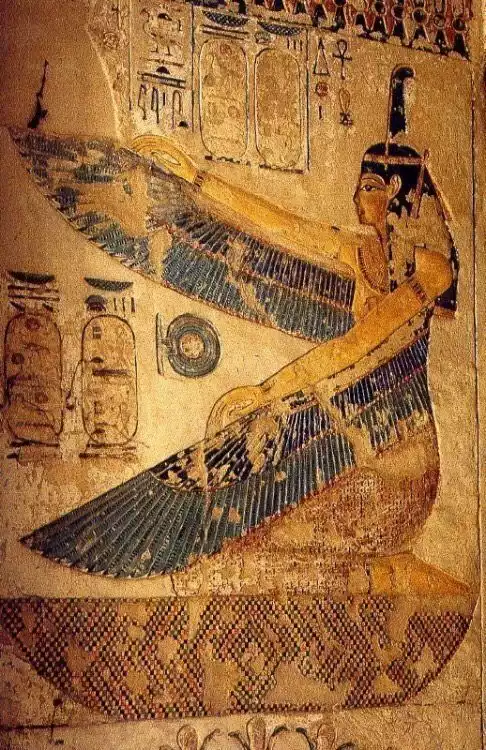
Hathor was the deity most intimately associated with love, sensuality, and feminine allure. Her temples were centers of music, dance, and ecstatic ritual. Priestesses of Hathor were often skilled in the arts of perfumery and adornment, understanding that seduction was both spiritual practice and social currency. In the context of love magic, Hathor was not merely invoked—she was embodied. A woman seeking to attract a lover might anoint herself with oils consecrated in Hathor's name, wear amulets bearing her image, and recite hymns that praised the goddess's beauty and magnetism.
The use of perfume in Egyptian attraction rituals cannot be overstated. Scent was considered a divine language, a way to communicate directly with the gods and with the unconscious mind of the desired. Kyphi, a complex blend of honey, wine, myrrh, and other aromatics, was burned in temples and homes alike. It was said to induce dreams, open the heart, and create an atmosphere conducive to intimacy. To wear perfume was to wear divinity—to become, for a moment, irresistible.
Isis and the Magic of Names
If Hathor governed seduction, Isis governed transformation and resurrection. Her mythology is steeped in magical prowess. She tricked the sun god Ra into revealing his true name, thereby gaining power over him. This story illustrates a core principle of Egyptian magic: to know someone's true name was to possess authority over them. In love spells, names were written on papyrus, spoken aloud in ritual contexts, and sometimes hidden inside figurines or amulets designed to bind one person to another.
Papyri recovered from ancient sites reveal the structure of these spells. They are meticulous, formulaic, and dense with symbolism. A typical attraction spell might instruct the practitioner to write the name of the desired on a piece of linen, anoint it with a specific oil, tie it with red thread, and bury it at a threshold or near flowing water. The knot itself was a symbol of binding—an act that physically represented the tying together of two souls or wills.
Some texts go further. They speak of erotic binding practices—rituals designed not merely to attract but to obsess. These spells invoked chthonic deities, spirits of the dead, and forces associated with compulsion rather than gentle persuasion. The language used in such incantations is urgent, almost violent. The practitioner demands that the target think of no one else, eat without satisfaction, sleep without rest, until they return. Such practices blur the line between love and control, desire and domination—a tension the Egyptians did not shy away from.
Ritual Objects and Material Symbols
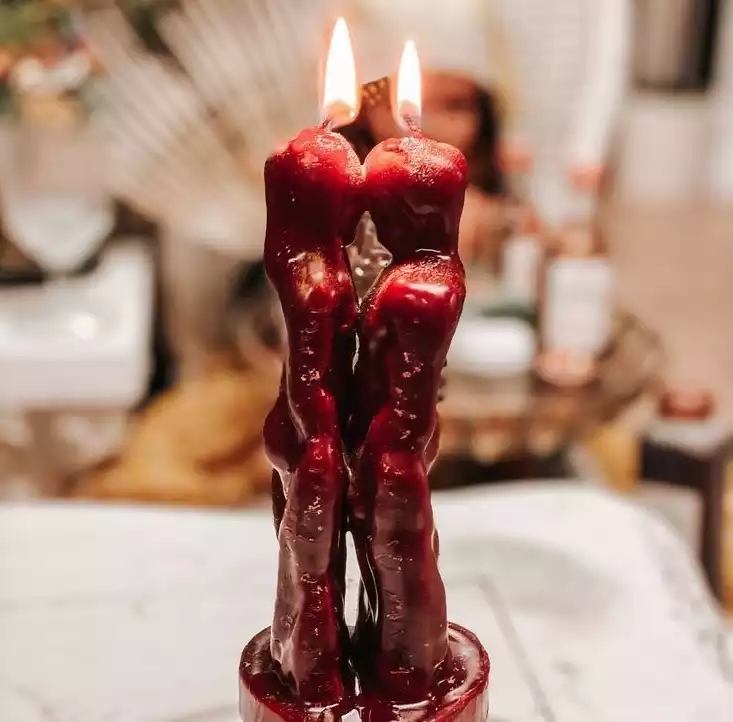
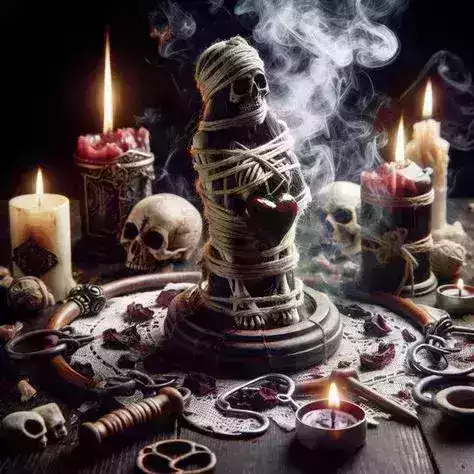
Egyptian love magic was deeply material. It required objects, substances, and gestures that anchored intention in the physical world. Figurines molded from clay or wax were common. These representations of the desired person could be inscribed with their name, pierced with pins, bound with thread, or placed near fire to "heat" the target's emotions. The logic was sympathetic: what was done to the image would be felt by the person it represented.
Amulets played a central role as well. Small carvings of Hathor, Bes (a dwarf god associated with fertility and protection), or symbols like the ankh and the tyet knot were worn close to the body. These objects were not passive. They were activated through ritual—consecrated with prayers, anointed with oils, and charged with the wearer's intention. To carry such an amulet was to carry a piece of the divine into everyday life, a constant assertion of one's desires before the gods.
Written spells on papyrus were equally potent. These texts often began with elaborate invocations, calling upon multiple deities and cosmic forces to witness and empower the working. The language was formal, rhythmic, almost hypnotic. Repetition was used deliberately—names and phrases echoed throughout the spell to build momentum, to imprint the intention deeper into the fabric of reality. The papyrus itself, inscribed with sacred words, became a talisman. It might be folded, sealed, and worn in a pouch, or dissolved in liquid and consumed, so that the magic entered the body directly.
Reconciliation and the Restoration of Affection
Not all love magic in ancient Egypt was concerned with new attraction. Many rituals focused on reconciliation—the mending of broken bonds, the restoration of cooling passion. These workings were often more complex, requiring purification, offerings, and appeals to Isis in her role as healer and restorer. A lover might bring offerings to her temple: milk, honey, bread shaped like hearts, and garlands of flowers. They would recite prayers asking for the softening of a hardened heart, the return of warmth where coldness had settled.
In some cases, reconciliation rituals involved both parties. Couples seeking to renew their bond might undergo a joint ceremony, sharing consecrated wine, exchanging tokens anointed with oils, and speaking vows before a statue of a love deity. These practices acknowledge something profound: that love is not only emotion but covenant, not only feeling but deliberate construction.
The Psychology of Enchantment
To modern eyes, it is tempting to reduce ancient Egyptian love spells to superstition or metaphor. But such reduction misses the nuance of how these practices functioned. The rituals were psychologically sophisticated. They required focus, preparation, and emotional investment. In performing a love spell, the practitioner was not merely hoping for external intervention—they were transforming themselves. The act of ritual created certainty, cultivated confidence, and focused desire into coherent intention.
Consider the aesthetics again: the preparation of oils, the careful writing of names, the donning of beautiful garments, the creation of a sacred space filled with light and fragrance. These actions shaped the practitioner's inner state. They induced a kind of enchantment—a self-hypnosis that made one feel more magnetic, more desirable, more powerful. Whether the magic "worked" because the gods intervened or because the practitioner's heightened state of being made them more attractive is a question the Egyptians would have found irrelevant. For them, these were not separate possibilities but two aspects of the same truth.
Obsession and the Ethics of Influence
There is a darker current running beneath the perfumed surfaces of Egyptian love magic. The same rituals that could summon affection could also bind, compel, and obsess. Papyri describe spells intended to drive a target to madness with longing, to fill their dreams with the image of the practitioner, to render them incapable of peace until they surrendered. These were not gentle invitations. They were acts of spiritual aggression.
The ethics of such practices were understood differently in antiquity. Personal autonomy, as we conceive it, was not the supreme value. Instead, the Egyptians believed in a cosmology of competing forces—divine will, fate, personal power, and social obligation all intersecting and sometimes conflicting. To use magic to influence another was not necessarily seen as violation but as the exercise of one's own divine right, a claim upon the world that every person possessed in different degrees.
Still, there were consequences. Practitioners understood that to invoke powerful forces for personal ends was to enter into relationship with those forces. Offerings had to be made. Rituals of gratitude and closure were necessary. To leave a working incomplete, to fail to honor the deities who had assisted, was to invite imbalance—and in Egyptian thought, imbalance was the root of all misfortune.
Beauty, Power, and the Divine Feminine
Central to Egyptian love magic was the concept of divine femininity as a form of power. Goddesses like Hathor and Isis were not merely patrons of love—they were embodiments of it, and their myths demonstrated that feminine sexuality and magical prowess were inseparable. Isis's ability to seduce, heal, and resurrect; Hathor's capacity to intoxicate and enchant—these were not soft, decorative qualities. They were forces that shaped kingdoms and destinies.
Women who practiced love magic were, in a sense, claiming kinship with these goddesses. They were asserting that beauty and desire were not frivolous but sacred, not passive but generative. To adorn oneself, to prepare potions, to speak incantations—these were acts of alignment with divine femininity, a participation in the creative power that the Egyptians believed moved the cosmos.
Men, too, engaged in love magic, often invoking male deities like Min, the ithyphallic god of fertility and sexual potency, or appealing to Hathor and Isis for favor. The rituals were similar in structure but varied in emphasis. Male practitioners might focus more on virility and dominance, while female practitioners emphasized allure and magnetism. Yet both understood that love, in all its forms, was a domain where human and divine intersected.
The Continuity of Desire Across Time
What remains striking about ancient Egyptian love spells is not their strangeness but their familiarity. The longing they express, the desperation, the hope—these have not changed. The mechanisms have evolved, the language has shifted, but the underlying architecture of desire remains constant. We still seek to be seen, to be chosen, to possess and be possessed. We still believe, in our own ways, that intention and action can shape outcome, that there is power in ritual, in symbol, in the deliberate construction of beauty.
The Egyptians understood something profound: that love is not only emotion but work, not only grace but craft. Their spells were not shortcuts but ceremonies, acknowledgments that what we desire most requires our full participation—body, mind, and spirit. To prepare the oils, to write the names, to light the candles and speak the words—these were affirmations of agency, declarations that fate itself could be negotiated through will and sacred action.
In the temples of the Nile, under skies thick with stars, priests and lovers alike performed their rituals. They believed that words had creative power, that beauty was divine, that desire could be sculpted like stone or woven like linen. And perhaps they were right. Perhaps magic, in the end, is simply the insistence that we are not powerless, that the world is responsive, that longing itself—when given form, voice, and ritual—can reach across the veil between what is and what might be.
We have inherited their symbols, their fragrances, their incantations. We may no longer invoke Hathor by name, but we still anoint ourselves before the mirror, still craft words meant to seduce, still believe that there is something sacred in the act of reaching toward another soul. In this, we remain Egyptian—worshippers at the altar of love, practitioners of an ancient and unending magic.
Comments
No comments yet. Be the first to share your thoughts!
Leave a Comment
Your email address won't be published. Comments are reviewed before being posted.