
 English
 Español
 Français
 中文
中文The architecture of desire in Santería is not built upon whim or romantic fantasy. It rests upon a foundation of spiritual hygiene—a deliberate dismantling of accumulated energies that cloud intention, distort will, and sabotage the practitioner's connection to the Orishas. To cast a love spell without first purifying the self is to plant seeds in contaminated soil. The ritual mechanics may appear flawless, the offerings meticulously arranged, yet the spell will wither before it blooms.
Santería cleansing is not a passive act of symbolic washing. It is an ontological reset, a recalibration of one's spiritual frequency to align with the forces one seeks to petition. The tradition recognizes that human beings accumulate layers of spiritual debris—envy from others, residual anger, psychic attachments, the miasma of previous failed relationships. These encumbrances create static in the communication between practitioner and deity, rendering even the most potent love magic ineffective or dangerously unpredictable.
The Doctrine of Spiritual Contamination
Within the cosmology of Santería, the human body is understood as a permeable vessel moving through a universe saturated with visible and invisible forces. Every interaction, every space inhabited, every emotional transaction leaves a residue. This residue—known variably as osogbo (misfortune), arayé (obstacles), or simply negative energy—accumulates in the aura, the chakras, and particularly in the head, which houses the orí, one's personal divinity and destiny.
Before approaching Oshun for matters of love, before lighting candles to Yemayá for emotional healing, before invoking Elegguá to open the roads to romance, the practitioner must acknowledge a fundamental truth: the Orishas respond to clarity. They are attracted to clean vessels. A spiritually contaminated individual seeking love may inadvertently attract obsession rather than devotion, possession rather than partnership, or simply receive no response at all from the divine realm.
The cleansing ritual is therefore not supplementary. It is the first act of magic, the prerequisite that transforms ordinary intention into consecrated will. In traditional ilé (house of Santería), no serious work is undertaken without prior purification. The godparent, the padrino or madrina, will assess the spiritual state of the individual through divination—typically with the diloggún (cowrie shells) or Ifá—to determine what specific cleansing protocols are required before love work can commence.
Hierarchies of Purification
Santería recognizes that not all contamination is equal, and therefore not all cleansing rituals carry the same weight. There exists a spectrum of purification, from simple daily maintenance to profound ceremonial interventions. Understanding this hierarchy is essential for anyone seeking to work love magic within this tradition.
The most basic level involves regular spiritual baths—baños de despojo—using herbs, flowers, and other botanicals aligned with specific Orishas. These are preventative measures, the spiritual equivalent of daily hygiene, designed to clear minor accumulations before they solidify into obstacles. For someone preparing to cast a love spell, these baths might incorporate basil for Oshun, coconut for Obatalá, or white roses for purity of intention.
The intermediate level includes limpias or cleansings performed by an initiated practitioner. These involve the use of eggs, white cloths, smoke from sacred herbs, or the ritual passing of live animals over the body to absorb negative energies. The limpia is diagnostic as well as therapeutic—the patterns formed by a cracked egg in water, for instance, can reveal the nature and source of spiritual contamination.
At the apex stands the ebó, a ceremonial offering prescribed through divination that addresses specific spiritual debts, curses, or profound imbalances. An ebó before love work might involve offerings to Elegguá to remove obstacles, to Oshun to sweeten one's romantic prospects, or to one's ancestors to gain their blessing and assistance. The ebó is not merely cleansing but transformation—it alters the practitioner's spiritual configuration at a fundamental level.
The Herbal Grammar of Santería Cleansing
The pharmacopeia of Santería is vast, each plant carrying specific spiritual properties understood through centuries of empirical observation and transmitted through lineage. Before love magic, certain herbs become particularly significant, their selection determined by the Orisha being petitioned and the nature of the romantic goal.
Albahaca (basil) is perhaps the most essential herb for love work preparation. Sacred to Oshun, the deity of love, beauty, and rivers, basil cleanses while simultaneously attracting sweetness and positive romantic attention. A bath of fresh basil leaves, preferably gathered near running water, removes bitterness from past relationships and opens the heart to new possibilities. The practitioner should bathe from head to foot, allowing the water to air-dry on the skin rather than toweling off, letting the herb's essence permeate the aura.
Ruda (rue) serves a different function—it is the great protector, the breaker of curses, particularly effective against the mal de ojo (evil eye) that often afflicts those who are attractive or in new relationships. Before casting a love spell, rue cleanses away envy and ill-will from others that might sabotage the magic. Its bitter smell is understood as repellent to negative entities.
White flowers—particularly white roses, carnations, and jasmine—are aligned with Obatalá, the father Orisha associated with clarity, peace, and pure intention. A bath incorporating these flowers before love work ensures that the practitioner's motivations are unclouded by manipulation, revenge, or ego-driven desire. Obatalá's energy purifies intention itself, which is crucial because love spells cast from impure motives typically backfire in Santería cosmology.
Cascarilla (eggshell powder) is used to create protective barriers and seal cleansing work. Drawn in crosses on the forehead, behind the ears, and at the base of the skull, cascarilla marks the practitioner as ritually clean and under the protection of the Orishas. Before attempting love magic, this simple act signals to the spiritual realm that one has prepared oneself appropriately.
Water as Ontological Medium
In Santería, water is not merely a physical substance but a spiritual conductor, a medium through which energies transfer and transform. The tradition distinguishes between types of water—river water, ocean water, rainwater, holy water—each carrying distinct properties and associated with different Orishas.
For love work, river water holds particular significance as the domain of Oshun. Ideally, water should be collected from a living river at dawn, when the boundary between worlds is most permeable. This water becomes the base for cleansing baths, charged with Oshun's essence and her particular affinity for matters of romance and attraction. The practitioner should approach the river with respect, offering honey or coins before collecting water, asking Oshun's permission and blessing.
Ocean water, sacred to Yemayá, the mother of all Orishas, is used when emotional healing is required before new love can enter. Those carrying trauma from previous relationships, unresolved grief, or maternal wounds must first cleanse with Yemayá's water. Seven waves should be allowed to crash over the body, each one carrying away layers of pain. Only after this emotional excavation can love spells be attempted without the risk of unconsciously recreating past patterns.
The ritual bath itself follows specific protocols. Water is prepared with herbs and flowers, sometimes sweetened with honey or perfumed with cologne aligned to the Orisha being petitioned. The practitioner bathes after sunset, in candlelight, often reciting prayers or moyuba (salutations to the Orishas and ancestors). The water is poured over the head in a specific number of iterations—often three, five, or seven, numbers carrying ritual significance. The used bathwater is not simply discarded; it must be disposed of properly, typically thrown at the base of a tree or carried to a crossroads, spaces where spiritual transformation occurs.

The Egg as Diagnostic and Therapeutic Instrument
The humble egg occupies a central position in Santería cleansing practice. Understood as a perfect vessel capable of absorbing spiritual contamination, the egg is both diagnostic tool and therapeutic agent. Before love work, an egg cleansing—limpia con huevo—reveals hidden obstacles and simultaneously removes them.
The practice is deceptively simple yet profound in its mechanics. A fresh white egg, preferably from a hen that has not been industrially farmed, is passed over the entire body of the person seeking cleansing. The practitioner or initiated guide moves the egg from crown to feet, paying particular attention to the heart chakra, the solar plexus, and the lower abdomen—energy centers crucial to romantic and sexual connection.
As the egg travels over the body, it absorbs spiritual debris, negative attachments, and energetic blockages. The person performing the cleansing may pray continuously, calling upon specific Orishas or reciting the Lord's Prayer, depending on lineage and tradition. The egg becomes heavier as it accumulates the invisible burden carried by the individual.
After the passing is complete, the egg is cracked into a glass of water, preferably placed beneath the bed overnight or immediately analyzed. The resulting patterns are read with the skill of augury—bubbles indicate the presence of negative spirits, cloudy whites suggest spiritual confusion or emotional turmoil, blood spots reveal active curses or deep-seated anger, and unusual formations in the yolk can indicate specific obstacles to love.
For someone preparing to cast a love spell, the egg reading provides crucial information. If the egg reveals significant contamination, the love work must be postponed until further cleansing is undertaken. Attempting to layer love magic over unresolved spiritual debris is not only ineffective but potentially dangerous, as it can bind the practitioner to toxic patterns or attract relationships that mirror their unhealed wounds.
Smoke, Sound, and Vibrational Cleansing
Beyond water and herbal baths, Santería employs smoke and sound as cleansing vectors. These methods work on subtler layers of the energetic body, addressing frequencies that liquid cannot reach.
Sahumerio—the burning of sacred resins, herbs, and woods—creates smoke that purifies spaces and individuals. Before love magic, the practitioner's ritual space must be cleansed with smoke from frankincense, myrrh, or palo santo. The smoke is directed toward the four cardinal directions, establishing a clean ceremonial container. The practitioner then passes through the smoke, allowing it to envelope the body, particularly focusing on the head and heart.
Certain lineages incorporate specific songs—cantos—dedicated to the Orishas as vibrational cleansing. Sound carries frequency, and the human voice, when properly trained and intentionally directed, can shatter energetic blockages. Before approaching Oshun with a love petition, singing her traditional songs creates resonance between practitioner and deity, clearing the channel through which communication will flow.
Drumming, the heartbeat of Santería ceremony, also serves a cleansing function. Even for solitary practitioners unable to convene a full tambor (drum ceremony), listening to recorded batá rhythms while preparing for love work helps to entrain one's personal vibration to the frequency of the Orishas. The complex polyrhythms disrupt stagnant energy patterns, creating movement where there was blockage.
The Role of Divination in Pre-Spell Cleansing
In traditional Santería practice, one does not simply decide to cast a love spell and proceed. The process begins with divination—consulting the oracle to determine whether the desired outcome is spiritually advisable, what obstacles exist, and what cleansing protocols are necessary before proceeding.
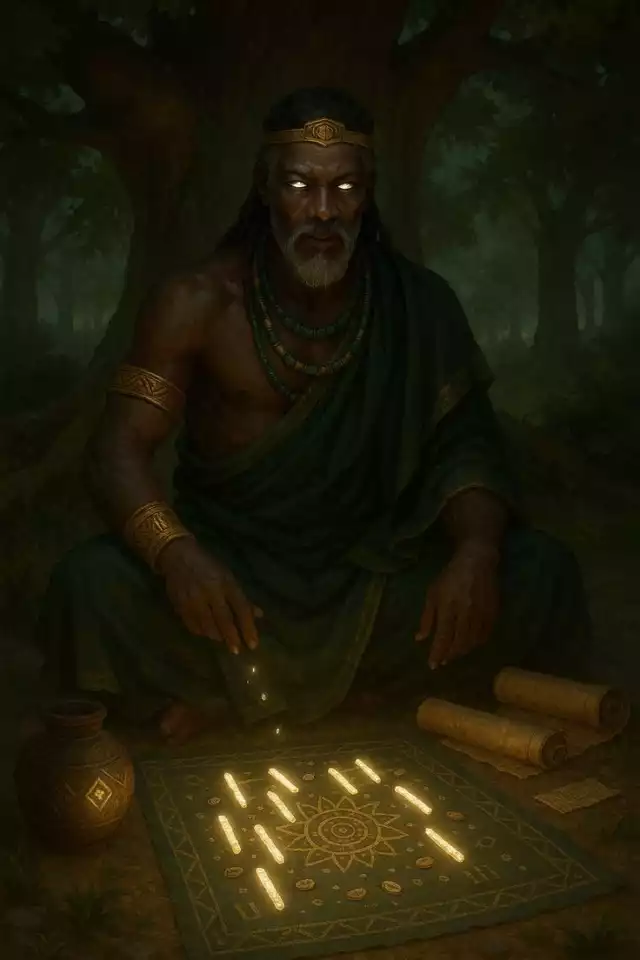
The diloggún, sixteen cowrie shells cast by initiated priests and priestesses, speaks with the voice of the Orishas. A reading before love work might reveal that the individual carries a spiritual debt that must be resolved first, that their head is "hot" with accumulated stress and requires cooling, or that a previous relationship has left energetic cords that must be severed before new love can enter.
Each of the sixteen primary oddús (signs) in the diloggún carries specific prescriptions for cleansing. Okana, the first sign, might prescribe cleansing with white cloths and coconut water to cool a turbulent spirit. Eyioko might require offerings to the ancestors before romantic work can proceed. Ogunda could indicate the need for protective cleansing against enemies who would sabotage one's love life.
Without this divinatory foundation, love magic in Santería becomes mere superstition—hopeful gestures disconnected from the intelligent spiritual forces that give the tradition its power. Cleansing prescribed through divination is specific, targeted, and exponentially more effective than generic rituals, because it addresses the actual spiritual condition of the individual rather than assumed needs.
Temporal Considerations and Lunar Alignments
The timing of cleansing rituals before love work is not arbitrary. Santería exists within a cosmology that recognizes the influence of celestial cycles, particularly the moon's phases, on spiritual work.
Cleansing baths are most potent during the waning moon, when the lunar energy supports release and dissolution. The two weeks from full moon to new moon create an ideal window for removing obstacles, clearing negative energy, and severing unwanted attachments. The practitioner working toward a love spell would ideally begin their cleansing protocol as the moon wanes, systematically removing everything that might impede the subsequent attraction work.
Conversely, the waxing moon—from new to full—supports growth, attraction, and manifestation. Once cleansing is complete, love spells are cast during this phase, when lunar energy amplifies intention and draws desired outcomes toward the practitioner. This creates a natural two-phase process: waning moon for purification, waxing moon for manifestation.
Certain days of the week also carry significance. Friday, associated with Venus and therefore with love and beauty, is ideal for both cleansing in preparation for romance and for the love work itself. Thursday, governed by Jupiter's expansive energy, supports work that seeks to increase one's romantic prospects broadly. Saturday, ruled by Saturn, is appropriate for cleansing away particularly stubborn obstacles or when the person has been deliberately cursed in matters of love.
Offerings and Spiritual Exchange
Central to Santería cosmology is the principle of aché—spiritual power or life force that circulates between humans and Orishas through offerings and reciprocity. Cleansing is not simply a mechanical removal of negativity; it is an exchange, a transaction within a sacred economy.
Before asking the Orishas for assistance in love, one must first give. This might be as simple as a glass of cool water placed before Obatalá, asking for clarity of mind and purity of intention. It might involve honey offered to Oshun at a river, accompanied by prayers requesting that she sweeten one's romantic prospects. For those with established shrines, it could be elaborately prepared dishes—adimú—specific to each Orisha whose assistance is being sought.
The offering is not bribery but acknowledgment. It recognizes that spiritual forces are not servants but sovereign entities with their own preferences and protocols. By offering what pleases them before requesting aid, the practitioner demonstrates respect and understanding of the reciprocal nature of the relationship between human and divine.
Moreover, offerings themselves function as cleansing agents. Honey poured over the head in a ritual bath to Oshun both purifies and attracts. White fabric offered to Obatalá can be used first to wipe away spiritual contamination before being presented at the shrine. The boundary between cleansing ritual and offering blurs, revealing that all ceremonial action in Santería is fundamentally about maintaining proper relationship with the forces that govern existence.
Ancestral Permission and Genealogical Cleansing
An often overlooked dimension of pre-spell cleansing in Santería involves the ancestors—egun or egúngún. Before the Orishas, before any spiritual work, one must attend to the ancestors, for they stand closest to the living and can either facilitate or obstruct one's efforts.
In matters of love, ancestral patterns carry particular weight. Wounds in the genealogical line—patterns of abandonment, abuse, infidelity, or lovelessness—can unconsciously replicate in descendants. Before casting a love spell, the practitioner must first cleanse and heal their relationship with the ancestral line, asking forgiveness for any disrespect, offering cool water and white candles, and requesting blessing rather than interference.
Some lineages perform specific misas espirituales (spiritual masses) before major magical work, creating space for ancestors to communicate any concerns or requirements. A grandparent in spirit might reveal that they oppose the intended relationship, or conversely, might offer to assist if properly petitioned. Ignoring ancestral input when pursuing love magic is considered dangerous—the ancestors have the power to close roads that the Orishas might otherwise open.
Genealogical cleansing might also involve healing family patterns through prayer, lighting candles for deceased relatives, visiting graves, or performing specific rituals to elevate ancestors who died in spiritual distress. This work is not quick, but for those whose family history is marked by romantic tragedy or dysfunction, it is absolutely essential before attempting to manifest healthy love through Santería magic.
The Psychological Dimension of Ritual Cleansing
While Santería operates within a framework of genuine spiritual forces and entities, it would be reductive to ignore the profound psychological dimensions of cleansing rituals. The tradition has always understood that the external and internal, the spiritual and psychological, are not separate domains but interwoven aspects of a unified reality.
When a person bathes with herbs, passes an egg over their body, or sits in ritual silence before ancestral shrines, they are not only performing spiritual mechanics. They are creating psychological space for transformation. The ritual actions externalize internal processes—the desire to release the past, to approach new love with clarity, to shed identities and stories that no longer serve.
The cleansing ritual functions as a threshold, a liminal space between who one was and who one is becoming. In preparing to cast a love spell, this threshold is particularly important. The person must psychologically separate from previous relationships, from narratives of unworthiness or romantic failure, from the wounded self that attracted or tolerated dysfunction. The ritual provides a container for this separation, making the invisible visible, the abstract concrete.
Moreover, the discipline of cleansing cultivates the psychological state necessary for effective magic: focused intention, patience, respect for process, and acknowledgment that transformation requires work. The person who rushes immediately to love spells without cleansing reveals an immaturity that will likely sabotage their efforts. The person who carefully prepares through purification demonstrates the seriousness and commitment that spiritual forces respond to.
Integration and the Continuum of Practice
Cleansing before love magic is not a single event but the beginning of an ongoing practice. Even after the initial purification, even after the love spell is cast, the practitioner must maintain spiritual hygiene. Regular baths, periodic limpias, continued offerings to Orishas and ancestors—these sustain the clarity achieved through initial cleansing and protect the magic as it unfolds.
Love, in Santería understanding, is not static. It is a living relationship that requires tending, just as one's relationship with the Orishas requires continuous attention. The person who cleanses once, casts a spell, and then abandons all spiritual practice will find their magic weakening, contamination creeping back in, and the desired relationship faltering or manifesting in distorted forms.
The tradition teaches sustainability—not dramatic one-time interventions but steady, consistent engagement with the spiritual dimension of existence. The cleansing rituals before love work initiate the practitioner into this larger understanding. They are not merely preparation for a spell but introduction to a way of being, a recognition that one's romantic life, like all aspects of existence, is embedded within a sacred order that must be respected, maintained, and honored.
As the relationship between practitioner and practice deepens, cleansing becomes less effortful, more intuitive. One develops sensitivity to the subtle signs of spiritual contamination—the feeling of heaviness, emotional reactivity disproportionate to circumstances, dreams populated by chaotic imagery. These become signals to return to the bath, to light candles, to seek divination, to refresh one's connection to the sources of purity and power.
In this way, the cleansing rituals before casting a love spell are not an isolated technique but an entry point into the broader practice of Santería itself—a tradition that understands love not as mere emotion or personal preference but as a force that flows through clean channels, responds to proper petition, and flourishes when humans align themselves correctly with the Orishas who govern the heart's mysterious country.
Comments
No comments yet. Be the first to share your thoughts!
Leave a Comment
Your email address won't be published. Comments are reviewed before being posted.