
 English
 Español
 Français
 中文
中文The deliberate choice of a candle's hue is not a gesture of aesthetic preference but a calculated invocation of energy, symbol, and intent. Across centuries of ritual practice—from the temple altars of Mediterranean mystery cults to the quiet hearths of modern solitary practitioners—the color of the flame's vessel has served as a bridge between material substance and immaterial aim. To light a candle is to speak without words; to select its color is to shape the language of that silence.
Color itself functions as a cipher, a code inherited not only from cultural tradition but from the deeper architecture of human perception. The eye recognizes wavelength; the mind interprets meaning. What has been red across cultures is seldom neutral: it signals vitality, danger, desire. What appears as white suggests purity, beginning, the erasure of preceding marks. The candle, as a ritual object, transforms these primal associations into operative tools. The wax becomes canvas; the flame, intention made visible.
The Historical Foundations of Color Symbolism
Long before the codified grimoires of early modern Europe prescribed specific hues for specific workings, human communities had mapped meaning onto the spectrum. Ancient Egyptian temple practices assigned pigments to deities: green for Osiris and regeneration, red for Set and the desert's wrath, black for Anubis and the fertile soil of the Nile. Such assignments were not arbitrary; they emerged from observation—of nature, of bodily processes, of the cycles that governed survival.
Medieval European ceremonial magic inherited these threads and wove them tighter. Texts like the *Key of Solomon* and the *Picatrix* detailed correspondences between planetary forces and chromatic expressions. Saturn's sphere demanded black or deep indigo; Venus required green or rose; Mars, predictably, red. The candle became a microcosm of celestial order, its color a signature tuned to cosmic frequency. To burn the correct shade was to align oneself with powers beyond the terrestrial plane.
Yet parallel traditions—folk practices carried by women in rural villages, African diasporic spiritualities transported across the Middle Passage—also cultivated sophisticated chromatic systems. In Hoodoo, candle color selection became an art of precision, where the nuance between royal blue and sky blue could determine a working's success. These traditions emphasized pragmatism over doctrine: the proof resided in results, not theological consistency.
White Candles: The Universal Solvent
If one color might be considered foundational to the practice, it is white. White candles hold a peculiar place in the architecture of candle magic, functioning simultaneously as symbol of purity and as universal substitute. When a specific hue is unavailable, white serves as the blank slate upon which intention alone may inscribe meaning. This is not dilution but concentration—the practitioner's will becomes the determinant factor, unmediated by external correspondence.
In ceremonial contexts, white candles mark beginnings, purifications, invocations of clarity. They cleanse spaces before more complex workings, establishing neutral ground. The color suggests the absence of stain, the presence of potential. It is the color of baptismal robes and burial shrouds alike—liminal, poised between states. To burn a white candle is to reset the field, to declare a space open and receptive.
Yet the whiteness must not be mistaken for passivity. In certain traditions, white represents the full spectrum collapsed into singularity, the totality of light before its prismatic division. It contains all other colors within its structure, latent and available. Thus the white candle becomes a tool of amplification, intensifying whatever intention the practitioner directs through its flame. It is foundation, yes, but also apex.
Black Candles: Erasure and Protection
The black candle has suffered misunderstanding born of cultural prejudice and cinematic caricature. Western associations of darkness with malevolence have obscured the true function of black within the ritual palette. Black candles do not inherently summon harm; they absorb, they banish, they create the necessary void into which new forms may emerge. The color speaks to endings, certainly, but endings are prerequisite to transformation.
In protective work, black candles serve as psychic shields, absorbing negative energies directed toward the practitioner. They establish boundaries, mark thresholds that malign influences cannot cross. The color's depth suggests infinite capacity to contain what is unwanted, to draw poison from a situation as a poultice draws infection from a wound. To burn a black candle is to declare what will not be tolerated, to invoke the power of refusal.
Simultaneously, black represents the fertile void of possibility—the primordial darkness before creation, the soil before the seed. In certain African traditional religions, black is the color of ancestral wisdom, of the deep knowledge carried by those who have crossed the boundary of death. Black candles in such contexts serve as conduits to lineage, as invitations extended to those who watch from the other side of the veil. The flame becomes a beacon in the darkness, calling forth guidance from realms unseen.
Red Candles: Vitality and Volition
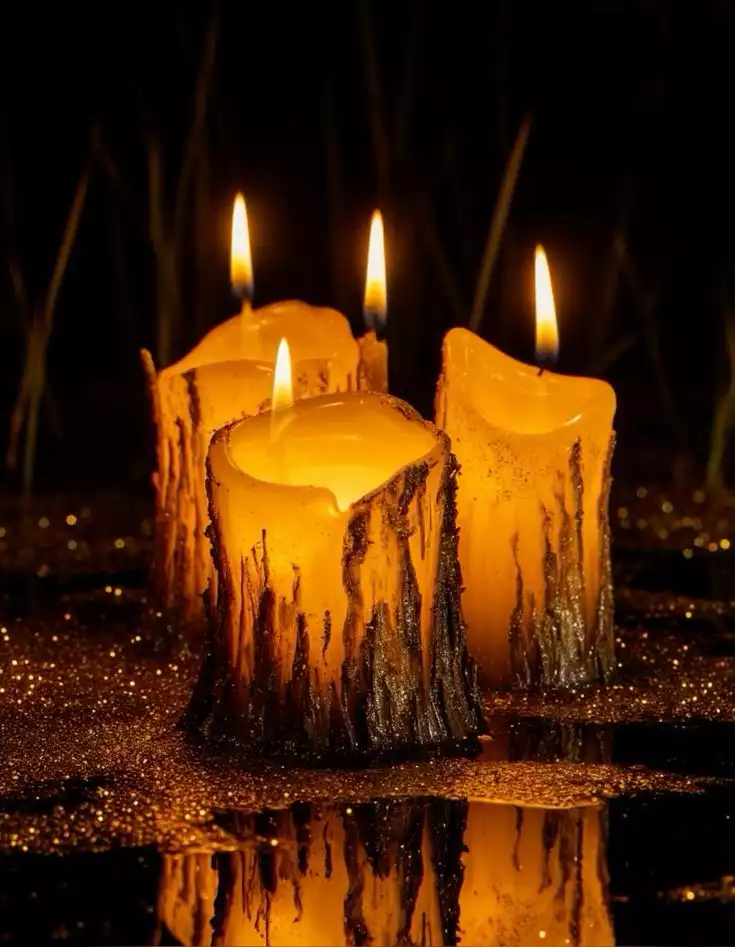
Red is perhaps the most visceral of colors, tethered to the body's own rhythms—the pulse of blood, the flush of arousal, the heat of anger. Red candles channel these primal forces into directed action. They are employed in workings of passion, whether romantic or martial, in spells designed to quicken energy, to incite movement, to break through stagnation with force.
The red candle belongs to Mars in astrological correspondence, to Aries and Scorpio, to the element of fire in its most aggressive expression. It is the color of warriors preparing for battle, of lovers surrendering to desire, of anyone seeking to impose their will upon resistant circumstances. The flame of a red candle burns with urgency; its work is not patient contemplation but immediate manifestation.
Yet red also corresponds to survival itself—to the root chakra in Eastern systems, to the foundational vitality that keeps the organism alive. In healing work, red candles may be employed to stimulate recovery, to restore depleted life force, to awaken systems that have grown dormant. The color reminds the body of its own power, calls forth reserves of strength that stress or illness may have suppressed. It is life asserting itself against entropy.
Green Candles: Growth and Prosperity
Green occupies the center of the visible spectrum, positioned between the cool blues and the warm yellows. This centrality mirrors its symbolic function: balance, fertility, the generative power of nature in its seasonal abundance. Green candles find their primary application in workings of prosperity, but prosperity understood broadly—not merely financial accumulation but the flourishing of enterprises, relationships, health, and creative projects.
The color carries agricultural associations: the first shoots of spring, the verdant fullness of summer, the promise of harvest. To burn a green candle is to align oneself with these cycles, to declare that what has been planted will grow. In money magic specifically, green represents not gold itself but the living energy that circulates through exchange, the movement of resources that sustains community and individual alike.
Green also governs matters of the heart, particularly in its connection to the heart chakra—love not as passion (which belongs to red) but as compassion, acceptance, the capacity to hold space for another. Green candles in emotional healing work help to restore balance after trauma, to reopen channels of feeling that fear may have closed. The color suggests renewal, the body's remarkable capacity to repair what has been damaged, to generate fresh tissue over old wounds.
Blue Candles: Truth and Tranquility
Blue, in its various shades, addresses the realm of communication, intellect, and spiritual elevation. Light blue candles foster peace, encourage meditation, invite the descent of calm into agitated spaces. They are the color of clear skies and still waters, environments where the mind can reflect without distortion. In healing work, light blue addresses fever, inflammation, conditions of excess heat requiring cooling balm.
Darker blues—royal, navy, midnight—correspond to deeper waters and higher wisdom. These shades invoke Jupiter's expansive influence, the pursuit of justice, the quest for philosophical or religious truth. Dark blue candles appear in workings designed to expand consciousness, to access intuitive knowledge, to petition for ethical guidance. They suit the scholar, the seeker, anyone navigating questions without simple answers.
In matters of expression, blue governs the throat chakra, the capacity to speak one's truth without violence or suppression. Blue candles assist in overcoming blockages of communication, whether internal censorship or external silencing. They create conditions under which difficult conversations become possible, where what has remained hidden can finally be articulated. The color suggests the courage required not for dramatic confrontation but for simple honesty.
Yellow Candles: Intellect and Illumination
Yellow channels the solar principle—not the sun's heat but its light, the capacity to illuminate, to make visible what shadow obscures. Yellow candles serve in workings of clarity, study, mental acuity. They sharpen focus, dispel confusion, assist in examination and analysis. Students before difficult tests, writers facing blank pages, anyone engaged in intellectual labor might employ yellow candles to invoke the organizing power of conscious attention.
The color also governs communication, particularly the playful, mercurial variety associated with the planet Mercury. Yellow candles facilitate networking, social connection, the movement of information between nodes. They are less serious than blue's truth-seeking, more dynamic than green's steady growth. Yellow is the color of commerce, gossip, letters delivered and messages received—all the small transactions that weave the social fabric.
In magical work specifically, yellow relates to conscious will, the directing force of the magician's trained intention. It represents the ego in its proper function: not inflated narcissism but the necessary "I" that chooses, decides, acts. To burn a yellow candle is to assert one's agency, to claim the power to shape circumstance through deliberate thought and planned action.
Purple Candles: Power and Sovereignty
Purple has long served as the color of royalty, of spiritual authority, of those who mediate between earthly and divine realms. Its expense in historical contexts—derived from rare mollusks, affordable only to emperors and high priests—linked the color permanently to notions of power and privilege. Purple candles in contemporary practice invoke this lineage, calling forth one's own sovereignty, one's right to claim space and voice.
The color corresponds to the crown chakra, the point of connection to transcendent consciousness. Purple candles facilitate meditation, astral work, any practice designed to expand awareness beyond ordinary perception. They create conditions favorable to vision, to prophetic dreaming, to the reception of messages from guides or higher aspects of self. Purple marks the threshold where the personal dissolves into the universal.
In workings of influence, purple candles assert mastery—not domination of others but command of one's own faculties and circumstances. They suit those seeking positions of leadership, recognition of expertise, the authority that comes from genuine competence. Purple does not beg or manipulate; it declares, and expects acknowledgment. The color carries an edge of danger: power without wisdom becomes tyranny, authority without compassion becomes cruelty.
Pink Candles: Affection and Reconciliation
Where red burns with passionate intensity, pink offers gentler affections—friendship, familial love, the early stages of romance before desire overwhelms. Pink candles foster tenderness, encourage emotional openness, create atmosphere conducive to vulnerability. They appear in workings designed to mend relationships, to ease tensions, to remind estranged parties of the bonds that once connected them.
The color also addresses self-love, that notoriously difficult practice of extending to oneself the compassion readily offered to others. Pink candles in personal healing work help to soften the internal critic, to cultivate patience with one's own failings, to recognize that worthiness is not earned but inherent. They create internal conditions where growth becomes possible because harshness has been temporarily suspended.
Pink appears frequently in beauty and attraction spells, though not for crude manipulation. Rather, it helps the practitioner to recognize and project their own appeal, to shed the shame or doubt that obscures natural charm. The color does not create attractiveness but reveals what was always present, veiled by fear or negative conditioning.
Orange Candles: Success and Adaptability
Orange blends red's vitality with yellow's intellectual clarity, producing a color of action informed by strategy. Orange candles accelerate projects, help to overcome obstacles through creative problem-solving, encourage adaptability in changing circumstances. They suit the entrepreneur, the artist seeking to manifest vision in material form, anyone engaged in the challenging work of bringing idea into reality.
The color governs the sacral chakra, seat of creativity and pleasure. Orange candles in ritual work stimulate these capacities, reminding the practitioner that joy is not frivolous but necessary fuel for sustained effort. They combat the deadening effects of routine, inject spontaneity into rigid systems, suggest alternatives when familiar methods fail.
In legal matters and worldly success, orange provides the energy to persist through bureaucratic frustration, to maintain optimism when outcomes remain uncertain. The color does not guarantee victory but ensures that defeat will not result from loss of momentum or premature surrender. Orange is the color of those who refuse to quit, who understand success as iterative process rather than single event.
Brown Candles: Earth and Endurance
Brown, often overlooked in favor of more dramatic hues, addresses the practical foundations of existence—home, work, physical security. Brown candles ground scattered energies, reconnect the practitioner to material reality after periods of excessive abstraction. They are the color of soil, of wood, of all the substances from which shelter and sustenance derive.
In animal magic and work involving familiar spirits, brown candles establish the necessary earthly anchor. They help to maintain physical well-being during intensive spiritual practice, preventing the dissociation that can result from overemphasis on non-material realms. Brown reminds the practitioner that incarnation itself is sacred, that the body is not prison but temple.
Brown also governs matters of endurance—not dramatic heroism but the quiet persistence required to maintain commitments over years, to build slowly what will last. It is the color of farmers and craftspeople, of anyone who understands that meaningful work unfolds across seasons, not moments. To burn a brown candle is to honor the long haul, to commit to processes whose results will not immediately manifest.
Silver and Gold: Lunar and Solar Principles
Metallic candles occupy a special category, representing not earthly substances but celestial powers. Silver channels lunar energies—intuition, psychic receptivity, the hidden movements of the unconscious. Silver candles enhance divination, facilitate dreamwork, open pathways to subtle perception. They belong to the night, to the goddess in her triple aspect, to all practices that embrace mystery rather than demanding certainty.
Gold embodies solar force—not merely success or wealth but the life-giving power of the sun itself, the organizing principle around which lesser bodies orbit. Gold candles in ritual work invoke divine blessing, cosmic favor, the sense of being aligned with larger patterns of meaning. They suit workings of great ambition, projects intended to benefit not only the self but community, legacy-building in all its forms.
These colors, being reflective, also serve to amplify the energies already present. A gold candle does not create success from nothing but magnifies existing potential, helps to make visible what was overlooked, draws attention from those with power to assist. Silver similarly intensifies intuitive capacities already latent, helping the practitioner to trust perceptions that rational mind might dismiss.
The Practice of Selection
Understanding the symbolic architecture of candle colors provides vocabulary, but application requires discernment. The correspondences outlined above are not rigid laws but flexible frameworks, interpretable according to tradition, intuition, and specific circumstance. A practitioner working within Hoodoo may assign meanings slightly different from one trained in Wiccan practice; both systems function because internal consistency matters more than universal agreement.
The moment of selection—standing before an array of candles, weighing options, feeling for the right choice—is itself a minor act of magic. Often the hand reaches without conscious decision, drawn to a color whose relevance will only become clear as the working unfolds. This intuitive pull should not be dismissed in favor of intellectual correspondence alone. The body possesses its own wisdom; the eye recognizes what it needs.
When multiple colors seem applicable to a single working, layering becomes possible. A spell for creative success might combine orange for manifestation, yellow for mental clarity, and green for growth. The candles may be burned simultaneously or in sequence, each adding its signature to the overall composition. Such layering increases complexity but also precision, allowing the practitioner to address multiple dimensions of a situation within a single ritual frame.
Finally, the importance of candle color must be balanced against the understanding that no tool functions independently of the consciousness wielding it. A white candle lit with focused intention will accomplish more than an elaborate array of perfectly corresponded colors ignited mechanically, without genuine investment. The color provides structure, suggestion, symbolic reinforcement—but the engine of the work remains the practitioner's will, clarified and directed through the grammar of flame and hue.
In this sense, the study of candle colors represents not the accumulation of external rules but the development of an internal language, a vocabulary through which intention learns to speak itself into being. The colors are alphabet; the flame, syntax; the practitioner, author of meanings yet to be written.

Comments
No comments yet. Be the first to share your thoughts!
Leave a Comment
Your email address won't be published. Comments are reviewed before being posted.