 English
 Español
 Français
 中文
中文The notion of a pact with Lucifer occupies a contested space in Western esotericism, suspended between ecclesiastical propaganda, authentic ritual tradition, and the psychological architecture of transgression. What emerges from historical examination is not a singular practice but a constellation of approaches—ranging from ceremonial invocations preserved in grimoires to intimate contracts negotiated in solitude—each bearing witness to humanity's enduring compulsion to negotiate with forces perceived as existing beyond the threshold of sanctioned cosmology.
The severity of these rituals cannot be understated. They demand not merely intellectual curiosity but a willingness to dismantle personal identity, to surrender the protections afforded by conventional morality, and to stand naked before the mirror of one's most profound desires. This essay traces the historical lineage of the Luciferian pact, examines its ritual architecture, and considers the psychological and spiritual costs embedded within its practice.
The Medieval Genesis: Ecclesiastical Fear and Grimoire Tradition
The formalized concept of a demonic pact emerges most distinctly during the late medieval period, shaped by theological anxieties surrounding heresy, apostasy, and the perceived erosion of Church authority. The witch trials of the fifteenth through seventeenth centuries codified a narrative wherein individuals—primarily women—were accused of renouncing Christ, signing contracts in blood, and receiving diabolical marks as tokens of their allegiance. Yet beneath this propaganda lies a substratum of genuine esoteric practice, preserved in texts that circulated among learned magicians, disaffected clergy, and those who sought power through means the Church could neither control nor comprehend.
Grimoires such as the Grimorium Verum, the Grand Grimoire, and the Clavis Inferni contain explicit instructions for summoning Lucifer or his emissaries. These texts present ritualistic frameworks that are remarkably consistent: the establishment of sacred time and space, the preparation of sigils and seals, the recitation of invocations designed to compel appearance, and the negotiation of terms. The Grand Grimoire, attributed to various authorship but likely a composite work of the eighteenth century, describes a pact ritual with Emperor Lucifuge Rofocale that requires the magician to prepare a parchment made from the skin of an unborn lamb, inscribe it with blood drawn from the left hand, and present demands in language both precise and deferential.
These grimoires reflect a worldview in which the cosmos is populated by hierarchical intelligences—angels and demons alike—who respond to the correct application of ritual technology. Lucifer, in this framework, is not merely a fallen angel but a sovereign intelligence governing realms of knowledge, wealth, and transformation unavailable through conventional religious channels. The pact is conceptualized as a contract between equals, albeit unequal in power, bound by cosmic law and enforced through mechanisms both supernatural and psychological.
Theological Constructions and the Problem of Sovereignty
Christianity's construction of Lucifer as the archetypal adversary provides essential context for understanding the pact's symbolic weight. The name itself—"light-bearer"—derives from the Latin translation of the Hebrew helel ben shachar in Isaiah 14:12, a passage that Church fathers interpreted as describing Satan's fall from heaven. This narrative of rebellion, pride, and subsequent exile establishes Lucifer not as a figure of pure evil but as one of tragic grandeur, a being who chose autonomy over obedience, knowledge over submission.
The pact with Lucifer thus becomes an act of theological rebellion, a conscious choice to align oneself with the principle of individual sovereignty rather than divine authority. Augustine and later Aquinas wrestled with the implications of such contracts, ultimately concluding that any pact with demons was both spiritually catastrophic and legally binding—a position that granted demonic entities a disturbing degree of ontological legitimacy. If demons could enforce contracts, they possessed a form of cosmic standing, a recognition that troubled theologians even as it empowered those willing to navigate the dangerous borderlands between sanctioned and forbidden knowledge.
The Architecture of the Ritual: Elements and Execution
The traditional Luciferian pact ritual is constructed around several foundational elements, each contributing to the psychological and spiritual intensity of the operation. Understanding these components reveals the severity inherent in the practice—a severity that derives not from theatrical excess but from the deliberate dismantling of psychological defenses and the invocation of forces that challenge the stability of the practitioner's worldview.
The first element is temporal: rituals are typically conducted during liminal periods—midnight, the dark moon, or dates associated with transgression such as Walpurgisnacht or the solstices. These times are understood as moments when the membrane between worlds grows permeable, when the ordinary structures of consciousness become negotiable. The magician enters a state of ontological vulnerability, operating in a space where conventional protections no longer apply.
Spatial preparation follows. The ritual space must be isolated, purified, and marked with protective circles or boundary sigils. Paradoxically, the circle serves dual purposes: it protects the magician from forces summoned, but also concentrates their will, creating a microcosm wherein their intention becomes law. The triangle of manifestation, often positioned outside the circle, provides a designated space for the entity to appear, establishing clear boundaries between the human and the numinous.
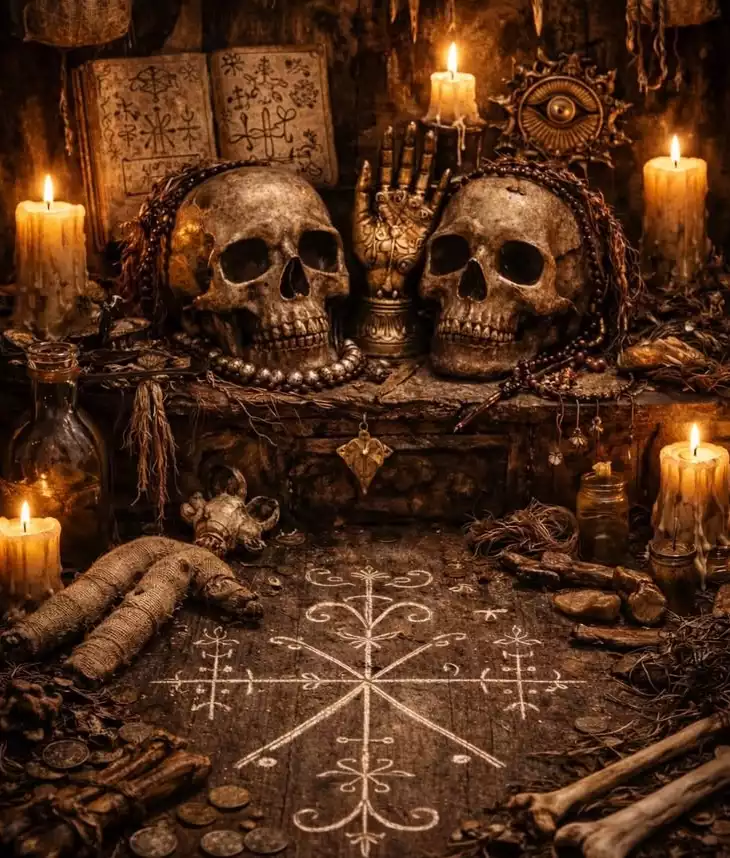
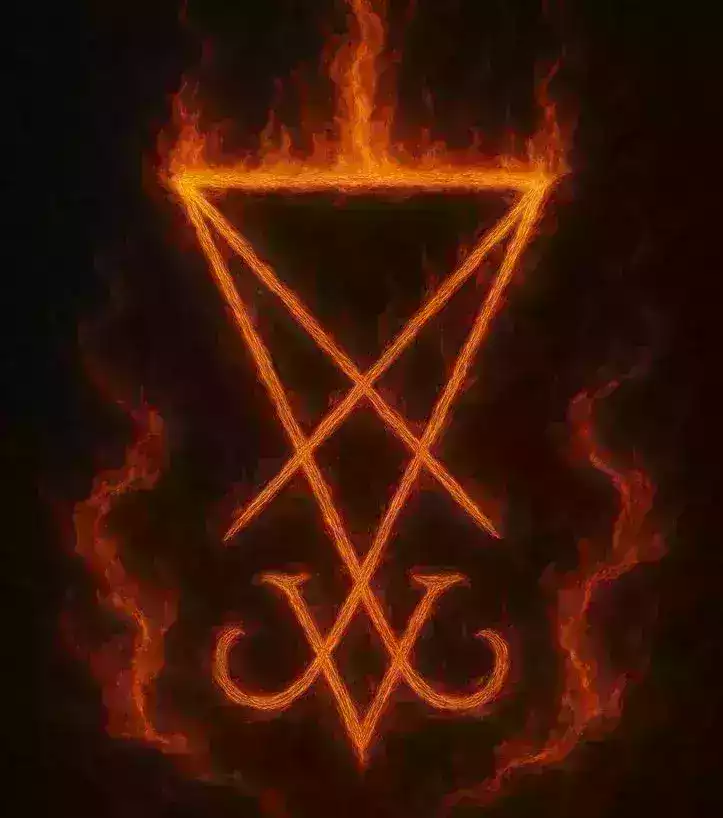
The seal or sigil of Lucifer constitutes the ritual's focal point. These graphic symbols—found in grimoires like the Grimorium Verum or designed through personal gnosis—function as both address and conduit. They are not merely decorative but operational, encoding relationships between letters, numbers, and cosmic principles that purportedly resonate with the entity's essential nature. The act of inscribing the sigil, particularly when done with materials of symbolic significance—blood, ashes, consecrated ink—becomes a preliminary act of commitment, a statement of intent that precedes and prepares for the actual encounter.
The Invocation: Language as Binding Force
The spoken component of the ritual carries particular weight. Traditional invocations combine biblical phraseology, barbarous names, and explicit statements of intent. The Grand Grimoire's conjuration of Lucifuge exemplifies this approach: "I conjure thee, O Lucifuge Rofocale, by the living God, by the true God, by the holy God, who spoke and all was made, who commanded and all things were created and made! I conjure thee by the ineffable names ON, ALPHA and OMEGA, ELOY, ELOYM, YA, SADAY, LUX, MUGIENS, REX, SALUS, ADONAY, EMMANUEL, MESSIAS..."
This amalgamation of divine names and commanding language reflects a magical philosophy wherein knowledge of true names grants power over the named. Yet the invocation also establishes the terms of engagement: the magician speaks with authority derived from cosmic law rather than personal whim. The severity of this moment cannot be overstated—the practitioner is essentially declaring their right to command forces that exist outside human jurisdiction, a declaration that carries both metaphysical and psychological consequences.
In more contemporary Luciferian practice, influenced by the philosophical works of Anton LaVey, Michael W. Ford, and others, the invocation may be reframed as an internal dialogue, a summoning of one's own latent potential symbolized by the Luciferian archetype. Yet even in this psychological model, the ritual retains its intensity, demanding confrontation with aspects of the self that ordinary consciousness prefers to keep sequestered.
The Contract: Terms, Payment, and the Question of the Soul
The pact itself—the actual agreement between magician and entity—represents the culmination of the ritual process. Historical accounts, both from trial records and grimoire instructions, describe contracts written in the practitioner's blood upon virgin parchment, signed with the magician's name or a symbolic mark, and counter-signed by the entity or its representative. The terms typically specify what the magician seeks—wealth, knowledge, power, sexual fulfillment, vengeance—and what is offered in exchange.
The payment structure varies significantly across traditions. The most famous formulation involves the surrender of one's soul following death, a transaction immortalized in the Faust legend and its numerous literary iterations. Yet grimoire traditions often describe more nuanced arrangements: service for a specified period, the sacrifice of specific virtues or relationships, or the performance of tasks that align with the entity's agenda. Some texts suggest that the "soul" in question is not the entirety of one's being but specific aspects—innocence, compassion, faith—that must be surrendered to accomplish the transformation the magician seeks.
The severity here is existential. By formalizing a contract with Lucifer, the practitioner acknowledges a worldview in which such transactions are ontologically possible, in which one's essential being can be alienated, traded, or transformed through agreement with non-human intelligence. Whether this transaction occurs on a literal plane or within the architecture of consciousness is perhaps less significant than the psychological commitment it represents—the willingness to stake one's fundamental identity on the efficacy of the ritual and the reality of the entity invoked.
Historical Exemplars: Documented Cases and Literary Legends
The historical record contains numerous accounts of individuals purported to have entered into Luciferian pacts, though the veracity of these accounts remains contested. The most famous is Johannes Faustus, the historical figure who inspired Marlowe's and Goethe's dramatic works. Contemporary accounts from the early sixteenth century describe Faustus as a wandering magician, astrologer, and charlatan who claimed supernatural knowledge and power, though whether this derived from genuine pact-making or skilled deception remains uncertain.
More extensively documented is the case of Urbain Grandier, the French priest accused of bewitching the Ursuline nuns of Loudun in 1634. During his trial, a document was presented purporting to be a pact signed by Grandier and counter-signed by multiple demons including Lucifer, Satan, Beelzebub, and others. The pact, written in mirror script, explicitly renounced God, baptism, and salvation in exchange for worldly pleasures and powers. Though almost certainly fabricated by Grandier's political enemies, the document reveals the period's conception of how such agreements were structured and what they entailed.
The witch trials across Europe and America produced thousands of confessions describing pacts with the Devil, though these were typically extracted through torture and reflect theological expectations rather than authentic practice. Yet within this coerced testimony occasionally emerge details—specific ritual gestures, invocations, or symbolic acts—that suggest continuity with genuine folk magical traditions predating Christianity's dominance.
Psychological Architecture: The Ordeal of Self-Confrontation
Beyond the external apparatus of ritual, the true severity of the Luciferian pact lies in its psychological dimension. To successfully execute such a ritual requires the practitioner to confront aspects of their psyche typically mediated by social conditioning, moral frameworks, and the defensive structures of the ego. The magician must acknowledge desires that civilization deems unacceptable, must claim authority that religious tradition reserves for divinity, and must accept responsibility for consequences that extend beyond the conventional boundaries of cause and effect.
Carl Jung's concept of the Shadow—those aspects of personality that consciousness rejects or refuses to recognize—provides a useful framework for understanding this process. The Luciferian pact can be interpreted as a ritual of Shadow integration, a deliberate invitation to forces that represent disowned aspects of the self. The severity of the ritual ensures that this integration cannot occur superficially; the elaborate preparation, the physical and psychological discomfort, and the existential stakes combine to create conditions under which genuine transformation becomes possible.
The pact demands what the esoteric philosopher Julius Evola termed "absolute individualism"—the assumption of complete responsibility for one's existence, unmediated by collective values or transcendent authority. This is perhaps the ritual's most profound ordeal: not the possibility of supernatural retribution but the burden of radical autonomy, the recognition that one has consciously chosen to operate outside the protective structures that most humans accept without question.
Material Components and Their Symbolic Density
The physical elements required for traditional pact rituals carry layers of symbolic significance that intensify the ritual's psychological impact. Blood, the most frequently cited component, represents life force, genetic identity, and the boundary between internal and external realms. To inscribe a contract with one's blood is to literally invest the document with one's biological essence, creating an object that exists at the intersection of matter and meaning.
The use of parchment made from virgin materials—unborn animals, or paper that has never been written upon—emphasizes purity and potential. The contract must be inscribed on a surface unmarked by previous meaning, ensuring that it carries only the intentionality of the current ritual. This attention to material purity reflects a worldview in which objects accumulate and transmit subtle influences, in which the history and composition of ritual tools directly affects their efficacy.
Additional components may include metals associated with particular planetary forces, herbs aligned with Luciferian correspondences—particularly those ruled by Venus (desire, beauty, transformation) or Mars (will, conflict, assertion)—and oils or incenses designed to create specific atmospheric conditions. The traditional use of sulfur, for instance, simultaneously references the element's alchemical significance and its association with infernal realms, creating a multivalent symbol that operates on sensory, intellectual, and unconscious levels.
The Question of Reversibility: Can a Pact Be Broken?
Both grimoire literature and theological discourse address the possibility of dissolving or escaping a demonic pact, though their conclusions differ significantly. Church doctrine generally held that while a pact could be renounced through sincere repentance and the intervention of ecclesiastical authority, the soul remained in grave danger and required extensive penitential practice to achieve redemption. Saints such as Theophilus of Adana and Cyprian of Antioch were celebrated precisely because they had entered into demonic pacts and subsequently achieved liberation through divine grace.
Magical traditions offer more varied perspectives. Some grimoires include procedures for dismissing entities and closing operations, though these are typically framed as temporary conclusions rather than permanent dissolutions of relationship. The underlying philosophy suggests that once a connection has been established with a particular intelligence or force, it can be managed, transformed, or temporarily suspended, but never entirely erased. The entity becomes part of the magician's experiential constellation, a reality that must be integrated rather than expelled.
Contemporary practitioners operating within psychological models face different but related challenges. If the "pact" is understood as a commitment to embody Luciferian principles—individual sovereignty, pursuit of knowledge, rejection of arbitrary authority—then "breaking" the pact would require a fundamental reorientation of identity and values. The severity here is existential rather than supernatural: one cannot un-know what has been learned, cannot easily reconstruct the comforting certainties that the ritual was designed to shatter.
Contemporary Practice: Adaptation and Philosophical Reframing
Modern Luciferian and Left-Hand Path traditions have substantially reinterpreted the pact ritual, though elements of severity remain. Organizations such as the Temple of Set, founded by Michael Aquino, and the various currents influenced by Michael W. Ford's Luciferian Witchcraft series, emphasize self-deification and the cultivation of personal power through disciplined engagement with archetypal forces. In these frameworks, Lucifer is understood not as an external entity but as a symbol representing human potential, enlightenment through rebellion, and the principle of conscious evolution.
The ritual of pact-making, in this context, becomes a formal commitment to one's own development, a psychodramatic operation that mobilizes unconscious resources and establishes clear intention. Yet even stripped of literal demonology, these rituals retain intensity. They require confrontation with one's limitations, honest assessment of desires that polite society condemns, and the willingness to pursue goals without the safety net of collective approval or divine forgiveness.
Some contemporary practitioners have developed hybrid approaches that acknowledge both psychological and potentially supernatural dimensions. They treat the ritual seriously, employ traditional methods, but remain agnostic about whether the forces encountered are autonomous entities, aspects of consciousness, or something that transcends this binary. This position—sophisticated ambiguity rather than naive literalism or reductive materialism—may represent the most intellectually honest approach to a phenomenon that has consistently resisted simple categorization.
The Sigillary Foundation: Seals as Covenantal Architecture
Within the specific context of demon sigils and seals, the Luciferian pact acquires additional layers of complexity. The seal functions as more than a mere address or symbol; it becomes the architectural foundation of the relationship established through the pact. To work with Lucifer's seal is to engage with a graphic syntax that purportedly encodes aspects of the entity's essential nature—patterns of force, characteristic modalities of manifestation, specific domains of influence.
Traditional seals of Lucifer, such as those appearing in the Grimorium Verum or derived from the planetary seal systems of Renaissance magic, combine geometric forms with sigillary characters. These are not arbitrary designs but intentional structures based on numerological principles, planetary correspondences, and what Renaissance magicians termed the "celestial alphabet"—a system of characters believed to resonate with cosmic forces more directly than conventional language.
The act of creating, consecrating, and activating a seal constitutes a preliminary pact in itself. The practitioner invests time, attention, and often physical materials of value into producing an object whose sole purpose is to facilitate connection with the entity. This investment creates what anthropologists might term a "symbolic debt"—having committed resources to the relationship, the practitioner becomes psychologically committed to its continuation. The seal thus functions as both tool and token, simultaneously enabling contact and serving as evidence of the contract's existence.
Ethical Considerations and the Problem of Consequence
Any honest examination of Luciferian pact-making must address the ethical dimension and the question of consequences. Traditional warnings about such practices are not merely ecclesiastical paranoia; they reflect genuine psychological and social risks. To seriously engage with these rituals is to deliberately alter one's relationship to consensus reality, to identify oneself—even privately—as someone operating according to principles that the surrounding culture finds threatening or incomprehensible.
The psychological risks are substantial. Individuals with unstable identity structures, unprocessed trauma, or tenuous connection to consensual reality may find that these rituals exacerbate existing vulnerabilities rather than producing empowerment. The ritual's deliberate evocation of fear, its symbolic transgression of protective boundaries, and its invitation to forces beyond ordinary consciousness can trigger dissociative episodes, paranoid ideation, or profound existential crisis in those unprepared for the experience.
Social consequences may prove equally severe. Even in relatively secular contemporary societies, individuals known to practice demonic magic face stigmatization, professional obstacles, and potential legal complications. The practitioner must evaluate whether the knowledge or power sought justifies these risks, and whether the transformation promised by the ritual serves their authentic development or merely enacts a rebellion against authority that might be addressed through less dangerous means.
The Hermeneutics of Experience: Interpretation and Validity
A final consideration involves the interpretation of results. Practitioners who perform Luciferian pact rituals report a wide range of experiences: vivid visions or apparitions, sudden opportunities or resources appearing in their lives, profound psychological shifts, or sometimes nothing discernible. The question of how to interpret these outcomes—as confirmation of supernatural contact, as psychological effects of focused intention, or as coincidence inflated by confirmation bias—remains contested.
The esoteric traditions themselves offer little consistency on this point. Some texts promise immediate, dramatic results; others counsel patience and suggest that the pact's effects may not manifest for years. This ambiguity serves a function: it protects the system from falsification while simultaneously demanding that practitioners develop their own hermeneutical frameworks, their own methods for distinguishing genuine results from wish fulfillment.
Perhaps the most sophisticated position recognizes that the question of "literal versus psychological" reality may be poorly formulated. The ritual creates effects—changes in behavior, perception, opportunity, and self-concept—that are entirely real regardless of their ontological status. Whether these effects result from traffic with autonomous entities or from mobilizing unconscious resources through elaborate psychodrama, they demonstrate that consciousness is more malleable, reality more responsive to intention, than conventional materialism acknowledges. The pact's validity, in this view, rests not on proving the independent existence of Lucifer but on demonstrating that human consciousness can be deliberately restructured through symbolic operations of sufficient intensity and coherence.
Conclusion: The Enduring Fascination with Forbidden Covenants
The Luciferian pact persists across centuries not because it offers easy power but because it addresses enduring human concerns: the desire for autonomy, the quest for hidden knowledge, the need to transgress limiting boundaries, and the compulsion to negotiate directly with forces that shape existence. Its severity—the elaborate preparation, the existential stakes, the potential consequences—functions as a filtering mechanism, ensuring that only those genuinely committed undertake the operation.
What the pact offers, whether interpreted literally or psychologically, is a technology of transformation that operates precisely because it demands totality. Unlike casual magical operations or superficial occult experimentation, the formal pact requires the practitioner to stake their identity, to declare through word and deed that they are willing to trade safety for sovereignty, comfort for knowledge, and the protections of collective morality for the burden of individual will.
The historical tradition, encoded in grimoires and preserved through secret lineages, continues to inform contemporary practice even as it undergoes philosophical reinterpretation. The seals and sigils, the blood and parchment, the midnight conjurations and binding oaths—these elements retain their power not through supernatural enforcement but through their capacity to create psychological conditions under which genuine transformation becomes possible. In this sense, the pact with Lucifer remains what it has always been: an ordeal of self-confrontation disguised as negotiation with divinity, a mirror held up to the darkest and most luminous aspects of human potential.

Comments (1)
Leave a Comment
Your email address won't be published. Comments are reviewed before being posted.