 English
 Español
 Français
 中文
中文Few texts in the Western esoteric tradition carry the weight and intrigue of the Ars Goetia, the first book of the Lemegeton Clavicula Salomonis, or Lesser Key of Solomon. This grimoire, emerging from the shadowed corridors of early modern European magic, presents a cosmology of seventy-two spirits—entities classified as demons, yet bound by the authority of King Solomon, the legendary biblical monarch whose wisdom was said to extend not only over earthly kingdoms but also over the invisible hierarchies of the infernal and celestial realms. The Goetia is not merely a catalog of names and seals; it is an intricate symbolic architecture, a map of forces both psychological and metaphysical, reflecting humanity's ancient compulsion to name, categorize, and command the unseen.
To understand the Goetia is to trace a lineage of magical thought that winds through Hellenistic theurgy, medieval Christian demonology, Renaissance Hermeticism, and modern occult revival. It is to recognize that these seventy-two demons are more than archaic curiosities—they are nodes in a network of symbolic meaning, expressions of internal and external realities that continue to captivate scholars, magicians, and seekers of hidden knowledge.
The Grimoire Tradition and Solomonic Authority
The Goetia belongs to a vast literature of grimoires—practical manuals of magic that proliferated in Europe between the thirteenth and eighteenth centuries. These texts claimed to transmit secret wisdom passed down from ancient sages, often invoking the authority of Solomon, whose biblical reputation for wisdom and control over spirits made him the ideal figurehead for magical operations. The Testament of Solomon, a Hellenistic Jewish or Christian text composed around the first to third centuries CE, established the archetype: Solomon, gifted with a magical ring bearing the Seal of God, compelled demons to reveal their names, functions, and means of exorcism, binding them to construct the Temple in Jerusalem.
This narrative provided both legitimacy and moral framing. By invoking Solomon, grimoires positioned themselves within a sacred lineage, suggesting that the conjuration of spirits was not merely permissible but divinely sanctioned when performed with proper knowledge and authority. The Goetia inherits this framework, presenting itself as a recovered Solomonic text, though its actual composition likely dates to the mid-seventeenth century, drawing on earlier sources such as the Pseudomonarchia Daemonum by Johann Weyer, published in 1577.
Weyer's work itself was polemical, intended to demonstrate the folly of demonic pacts by cataloging the demons and their deceptions. Yet the magical tradition seized upon such catalogs, transforming them from cautionary lists into operational manuals. The Goetia refines and expands this approach, offering detailed instructions for the evocation of each spirit, complete with sigils, offices, and legions commanded.
The Structure of the Seventy-Two
The Goetia enumerates seventy-two demons, each assigned a specific rank within an infernal hierarchy modeled on feudal and ecclesiastical structures. There are Kings, Dukes, Princes, Marquises, Presidents, Earls, and Knights—titles that mirror the social order of early modern Europe, projecting human structures of power onto the invisible world. This hierarchical arrangement is not arbitrary; it reflects a cosmological order in which even chaos and rebellion are subject to structure and law.
Each demon is associated with particular powers and attributes. Some grant wisdom, eloquence, or knowledge of the liberal sciences. Others confer abilities in matters of love, invisibility, discovery of hidden treasures, or command over spirits of the dead. A few are described as bestowing favor with rulers or revealing the past and future. The diversity of these functions suggests that the Goetia was envisioned as a comprehensive toolkit for the magician, a means of addressing nearly any conceivable need or ambition through negotiation with specific intelligences.
The spirits also possess distinctive forms and characteristics. They may appear as men, animals, hybrid creatures, or shifting shapes. Bael, the first demon, appears with three heads—those of a man, a toad, and a cat—and commands sixty-six legions. Paimon, one of the most prominent Kings, arrives with a retinue of musicians and appears riding a dromedary, crowned and majestic. Astaroth, a powerful Duke, is said to ride upon a dragon and hold a viper in his right hand, exuding a noxious odor unless constrained by magical rings. These vivid descriptions function as mnemonic devices, embedding each spirit's identity in the imagination of the practitioner and reinforcing the symbolic vocabulary of the operation.
Symbolic Architecture and the Seals
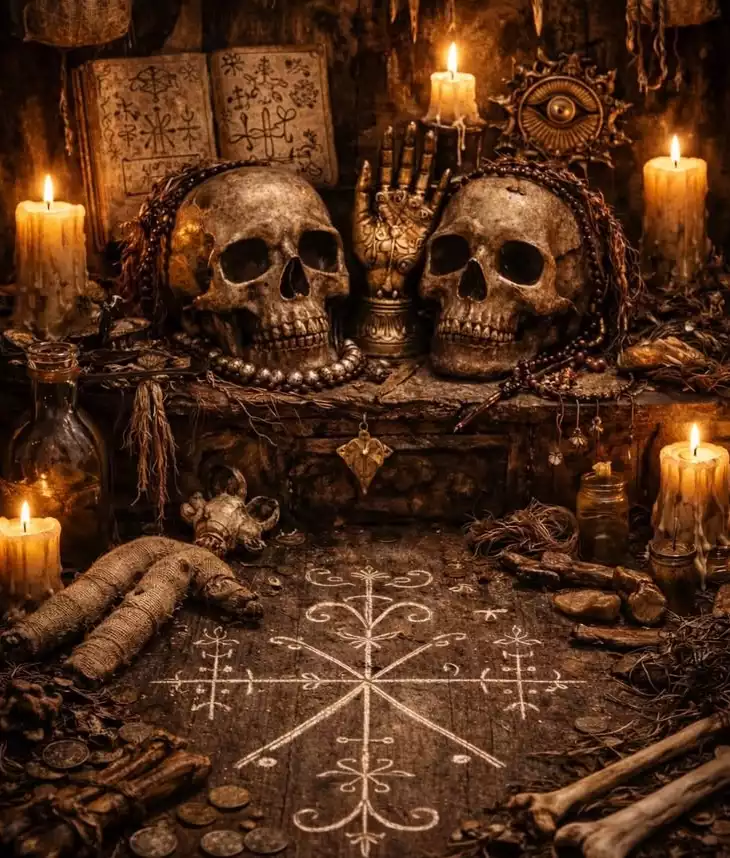
Central to Goetic practice are the sigils, or seals, associated with each demon. These are abstract geometric designs, often composed of lines, circles, crosses, and angular shapes, believed to encode the essence and name of the spirit. The magician inscribes these seals onto metal, parchment, or other materials as part of the ritual apparatus, using them as focal points for invocation and as instruments of authority.
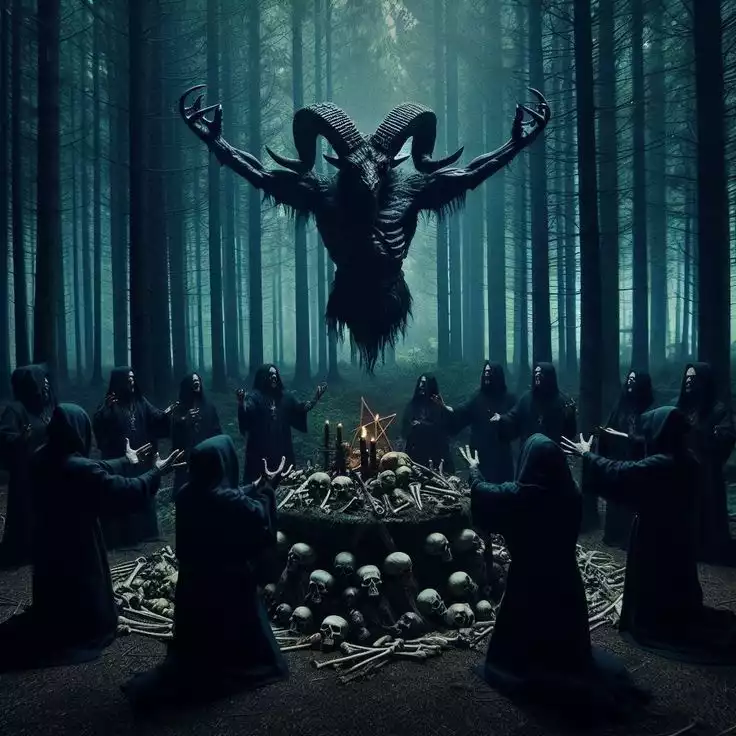
The sigils function within a broader symbolic system that includes the magic circle, the triangle of manifestation, protective pentacles, divine names, and ritual implements. The circle represents the sacred, protected space of the magician, inscribed with names of God and archangels to establish divine authority and prevent harm. The triangle, positioned outside the circle, is the place where the demon is commanded to appear, constrained within a bounded space where it can be observed and communicated with but not allowed to threaten the operator.
This spatial arrangement encodes a cosmological drama: the magician stands in the center of divine order, surrounded by protective names and symbols, while the demon occupies the liminal zone of manifestation, neither fully inside the sacred nor entirely beyond its reach. The operation is an enactment of sovereignty, a ritual assertion that the human will, aligned with divine authority, can command even infernal powers.
Origins and Textual Evolution
The precise origins of the Goetia remain obscured by the complex transmission of magical texts. The earliest known manuscript of the Lemegeton dates to the mid-seventeenth century, but it clearly synthesizes older material. The influence of Pseudomonarchia Daemonum is evident, and behind Weyer's work lie earlier grimoires, such as the Munich Manual and various Solomonic texts circulating in medieval Europe.
The number seventy-two itself carries symbolic weight. It echoes the seventy-two names of God in Kabbalistic tradition, the seventy-two nations descended from Noah in biblical genealogy, and the seventy-two disciples sent out by Christ. This numerological resonance suggests a deliberate attempt to construct a demonic counterpart to sacred hierarchies, a shadow pantheon that mirrors and inverts divine order.
The Goetia also reflects the syncretism characteristic of Renaissance magic. Its demons bear names derived from various sources: Semitic deities degraded to demons by monotheistic traditions (Astaroth from Astarte, Baal from the Canaanite god), Greek and Roman spirits, and inventions of medieval imagination. This layering of cultural memory demonstrates how the grimoire tradition absorbed and transformed diverse mythological material into a coherent system.
The Psychological Dimension
Modern interpretations of the Goetia, particularly those influenced by depth psychology and the occult revival of the nineteenth and twentieth centuries, have reimagined the seventy-two demons as representations of psychological forces rather than external entities. Figures such as Aleister Crowley and later practitioners within the chaos magic tradition have approached Goetic spirits as aspects of the unconscious mind, fragmented or repressed elements of the psyche that can be contacted, negotiated with, and integrated.
From this perspective, the ritual apparatus of the Goetia functions as a form of dramatic psychotherapy. The magic circle becomes the boundary of the conscious ego, the triangle a space where unconscious content is projected and given form. The sigils act as keys to specific complexes or archetypes, and the conjurations are performative invocations designed to bring hidden aspects of the self into awareness.
This psychological reading does not necessarily negate the traditional interpretation. Rather, it acknowledges that the symbolic language of the Goetia operates on multiple registers—mythological, cosmological, and psychological—and that the magician's experience may encompass all three dimensions simultaneously. Whether the demon appears as an external spirit, an autonomous psychological entity, or a symbolic construct may depend less on ontological reality than on the interpretive framework and experiential context of the practitioner.
Ritual Practice and Procedure
The Goetia provides detailed instructions for the evocation of spirits, emphasizing preparation, timing, and precision. The magician must construct or acquire specific implements: the magic circle, inscribed with divine names and angelic protectors; the triangle of manifestation, marked with the names Michael, Gabriel, and Raphael; a brass vessel or ring engraved with the demon's sigil; and a wand or sword symbolizing authority.
Timing is crucial. Operations are typically performed during planetary hours corresponding to the demon's nature, and some spirits are associated with particular directions or seasons. The magician must also prepare spiritually, often through fasting, prayer, and purification rituals, establishing a state of focused intention and moral authority.
The conjuration itself consists of a series of invocations, progressively escalating in intensity and authority. The magician begins by calling upon God, the archangels, and other holy names, establishing divine sanction for the operation. The demon is then summoned by name, commanded to appear visibly and peacefully, and bound by oaths to speak truthfully and perform the requested task. If the spirit is reluctant, further conjurations invoke increasingly severe threats and divine compulsion.
Once the spirit appears—whether as a vision, a voice, an intuitive sense, or a shift in atmospheric presence—the magician engages it in dialogue, stating the desired service and negotiating terms. The operation concludes with a license to depart, a formal dismissal that releases the spirit while maintaining the magician's authority and ensuring that no harm follows.
The Demons as Cultural Archetypes
The seventy-two demons of the Goetia have transcended their grimoire origins to become enduring cultural archetypes. They appear in literature, art, role-playing games, and contemporary occult practice, continually reinterpreted and reimagined. This persistence suggests that the Goetia taps into something fundamental in the human psyche: the need to personify and engage with forces that resist rational comprehension.
Demons such as Buer, depicted as a wheel with five legs radiating from a central head, or Stolas, who appears as an owl or raven and teaches astronomy and herbs, possess a surreal, almost hallucinatory quality that defies simple categorization. They are liminal figures, existing at the threshold between human and animal, reason and instinct, order and chaos. This liminality makes them powerful symbols for exploring the boundaries of identity, morality, and knowledge.
In contemporary practice, some magicians work with the Goetic spirits as patrons or guides, developing long-term relationships rather than engaging in isolated conjurations. This approach reframes the demons as allies or teachers, entities with whom one can collaborate rather than merely command. It reflects a shift from hierarchical, authoritarian magic to a more relational and exploratory model, though still rooted in the symbolic language and ritual structure of the grimoire tradition.
Theological and Philosophical Tensions
The Goetia exists within a complex theological framework, simultaneously affirming the reality of demons, the authority of God, and the capacity of the human magician to mediate between these forces. This creates inherent tensions. If demons are evil, fallen angels opposed to divine will, how can a pious magician justifiably command them? If they serve the magician's purposes, are they truly evil, or merely misunderstood?
Medieval and Renaissance theologians grappled with these questions, often condemning grimoires as blasphemous or heretical. The Church's position was generally that any commerce with demons, even if ostensibly for good ends, was dangerous and morally compromising, as demons were inherently deceptive and could never be fully trusted. The grimoire tradition countered by emphasizing the magician's alignment with divine authority, arguing that the conjuration of spirits was permissible when performed with sacred names and in service of lawful purposes.
This debate reflects broader philosophical questions about the nature of evil, the limits of human agency, and the relationship between knowledge and power. The Goetia, in its very structure, suggests that evil—or at least the forces classified as demonic—can be known, named, and controlled, that chaos can be subjected to order through ritual and will. Whether this is an act of spiritual hubris or a legitimate exercise of divine-human authority remains a point of contention.
Influence on Modern Occultism
The revival of interest in the Goetia in the late nineteenth and early twentieth centuries, particularly through the work of S. L. MacGregor Mathers and Aleister Crowley, brought the text into the mainstream of modern occultism. Mathers, co-founder of the Hermetic Order of the Golden Dawn, edited and published a version of the Lemegeton, making it accessible to a new generation of practitioners. Crowley, ever the iconoclast, conducted Goetic evocations and wrote extensively about his experiences, blending traditional methods with his own Thelemic philosophy.
Crowley's approach was both reverent and irreverent. He took the rituals seriously as transformative practices but also subjected them to critical scrutiny, reinterpreting them in light of modern psychology and his own cosmological system. His Illustrated Goetia, with illustrations by an unknown artist, became a seminal text, influencing countless subsequent practitioners.
In the latter half of the twentieth century, the rise of chaos magic and postmodern occultism further transformed Goetic practice. Magicians began to experiment with the forms and structures, treating the grimoire as a flexible template rather than a rigid dogma. Sigils were redesigned, rituals simplified or elaborated, and the ontological status of the demons left deliberately ambiguous. This pragmatic, results-oriented approach emphasized personal experience over traditional authority, democratizing access to the Goetia while also fragmenting its coherence as a unified system.
The Goetia in Contemporary Context
Today, the Goetia occupies a unique position in the landscape of Western esotericism. It is studied by historians of magic as a document of early modern occult thought, practiced by ceremonial magicians within traditional frameworks, and reimagined by contemporary practitioners as a resource for personal transformation and exploration. Online communities, forums, and digital grimoires have made Goetic knowledge more accessible than ever, while also multiplying interpretations and approaches.
This accessibility has led to both innovation and dilution. Some practitioners engage deeply with the historical and symbolic dimensions of the text, approaching it as a serious spiritual discipline requiring study, preparation, and ethical reflection. Others treat it as a menu of services, conjuring spirits casually for mundane goals without attention to the ritual or philosophical context. This spectrum reflects broader trends in contemporary spirituality, where traditional structures coexist with eclectic, individualized practices.
The Goetia also continues to provoke ethical questions. What does it mean to command a spirit, to impose one's will upon another consciousness, even a demonic one? How do power dynamics within the ritual space reflect or reinforce social hierarchies and assumptions about authority? These questions are particularly relevant in an era increasingly attentive to issues of consent, autonomy, and power.
Symbolism of the Seventy-Two
The number seventy-two, as noted, is rich with symbolic associations, but it also invites reflection on completeness and totality. In Kabbalistic thought, seventy-two represents a divine plenitude, a fullness of names and aspects of the Infinite. The Goetia's seventy-two demons may thus be understood as a complete taxonomy of human desire, fear, and ambition, a symbolic catalog of the forces that drive and torment us.
Each demon, with its specific attributes and offices, can be seen as embodying a particular mode of being or knowing. Vassago, a Prince who reveals lost or hidden things, might represent the desire for discovery and the recovery of forgotten knowledge. Gremory, a Duke who discovers hidden treasures and procures the love of women, embodies longing and the pursuit of the inaccessible. Bune, a Duke who makes men eloquent and wise, speaks to the aspiration for influence and intellectual mastery.
Collectively, the seventy-two demons form a mirror—imperfect, fragmented, yet revealing—of the human condition. They are the externalized aspects of our inner worlds, the parts of ourselves we have exiled, repressed, or refused to acknowledge. The Goetia offers a method for confronting these aspects, for bringing them into the light of consciousness, and for negotiating with them on deliberate terms.
Conclusion: The Enduring Power of the Goetia
The Goetia endures because it speaks to something perennial in the human experience: the encounter with the unknown, the desire to master forces beyond ordinary control, and the quest for knowledge that lies hidden beneath the surface of reality. It is a text that operates simultaneously as ritual manual, mythological compendium, and psychological map, offering multiple points of entry and interpretation.
Whether approached as a historical document, a living magical tradition, or a symbolic framework for self-exploration, the Goetia retains its power to fascinate and challenge. It invites us to consider the boundaries of the self, the nature of consciousness, and the architecture of invisible worlds. In its pages, seventy-two names await, each a key to a different mystery, a different mode of being. To engage with the Goetia is to step into a tradition that spans centuries, to stand at the threshold where the seen and unseen converge, and to ask what lies beyond the circle's edge.
Meta Description: Explore the Ars Goetia's seventy-two demons: origins, symbolic architecture, ritual practice, and their enduring influence on Western ceremonial magic and occult thought.
SEO Tags: Goetia, 72 demons, Ars Goetia, Lesser Key of Solomon, Solomonic magic, Goetic demonology, ceremonial magic, grimoire tradition, demon seals, occult grimoires, King Solomon demons, evocation rituals, infernal hierarchy
Comments
No comments yet. Be the first to share your thoughts!
Leave a Comment
Your email address won't be published. Comments are reviewed before being posted.