 English
 Español
 Français
 中文
中文At the crossroads where three paths converge, where the veil between worlds grows thin and shadows deepen into living presences, a figure stands motionless yet vibrantly alive. She holds two torches aloft, their flames casting light into realms that daylight cannot reach. Around her feet, hounds circle and whine, sensing what human perception cannot grasp. This is Hecate, goddess of witchcraft, keeper of keys, guardian of thresholds. For more than two thousand years, she has commanded the devotion of those who seek knowledge beyond the sanctioned boundaries of religion and reason.
Unlike deities who retreated into myth as empires crumbled and new faiths arose, Hecate has persisted. Her presence permeates grimoires, ritual manuals, spell-books, and contemporary altars with undiminished intensity. To understand why she remains the most powerful goddess of magic is to understand the architecture of transformation itself—the liminal spaces where power accumulates, where old selves dissolve and new identities emerge from darkness.
Who Is Hecate?
The origins of Hecate goddess trace back to pre-Olympian strata of Greek religion, though some scholars detect Anatolian or Thracian influences in her cult. What distinguishes her from other deities is the peculiar autonomy she retained even after absorption into the Hellenic pantheon. In Hesiod's Theogony, composed in the eighth century BCE, she receives an extraordinary tribute: Zeus himself honored her above all others, granting her dominion over earth, sea, and sky.
This was no minor goddess relegated to a single function. Greek goddess Hecate governed the night, presided over ghosts and spirits, ruled the crossroads where travelers made offerings to ensure safe passage. She possessed knowledge of herbs, poisons, and pharmakeia—the pharmaceutical and magical arts intertwined in ancient understanding. Midwives invoked her. So did those who sought communion with the dead.
Her worship was chthonic, rooted in the earth and underworld rather than the celestial heights favored by Olympian theology. Yet even the gods of Olympus recognized her authority. When Persephone descended into Hades' realm, it was Hecate who accompanied her, torch in hand, guiding the maiden through subterranean passages. This role as psychopomp—guide of souls—became central to her identity.
Hecate and Witchcraft
By the Hellenistic period, Hecate witchcraft had become synonymous. She appeared in magical papyri, invoked alongside demons and angels in complex rituals designed to compel love, inflict harm, or divine hidden truths. The Greek Magical Papyri, a collection of spells from Greco-Roman Egypt, repeatedly call upon her with epithets that reveal her scope: Brimo the Terrifying, Enodia of the Roads, Phosphoros the Light-Bringer.
Her connection to ancient witchcraft was not metaphorical. Practitioners of goeteia—low magic, often maligned by elite philosophers—considered her their patron. She granted access to spirits, facilitated necromantic consultations, governed the herbs gathered under moonlight for potions and poultices. In literary sources, witches like Medea and Circe operated under her aegis, their terrifying powers extensions of her own.
This association only intensified through late antiquity and into the medieval period. Christian polemicists portrayed her as a demon, yet grimoires preserved her invocations. The Key of Solomon and other medieval texts retained her name, testifying to an unbroken tradition of Hecate magic that survived theological condemnation.
The Symbols of Hecate
To approach goddess Hecate is to encounter a constellation of symbols, each a key to understanding her domains.
Hecate torches are perhaps her most recognizable attribute. She carries one in each hand, illuminating paths through darkness—not the comforting darkness of sleep, but the disorienting darkness of uncertainty, transition, death. These flames reveal what lies hidden, allowing passage through spaces that would otherwise trap the traveler in confusion or terror.
Hecate keys unlock doors between worlds. She is Kleidouchos, the Key-Holder, guardian of thresholds both literal and metaphorical. Her keys open gates to the underworld, to forbidden knowledge, to states of consciousness inaccessible through ordinary means. In ritual practice, keys become instruments of invocation, physical anchors for her presence.
The crossroads—triodos in Greek—constitute her sacred geography. At these junctions, travelers paused to honor her, leaving offerings before continuing their journey. Symbolically, crossroads represent moments of decision, crisis, transformation. Standing at such a place, one faces multiple futures simultaneously. Hecate goddess of crossroads presides over these moments, offering guidance to those who petition her with sincerity.
Hecate dogs accompany her nocturnal wanderings. Their howling announces her presence. In ancient understanding, dogs occupied liminal spaces themselves—domestic yet wild, loyal yet potentially dangerous. They guarded boundaries, detected invisible presences, consumed carrion. As her companions, they emphasize her sovereignty over the threshold between life and death.
Serpents coil around her arms in some representations, linking her to chthonic wisdom and regeneration. The moon, especially the dark moon, falls under her dominion. As Hecate moon goddess, she governs the phase when lunar light withdraws completely, when the night sky offers no illumination except what one carries oneself.
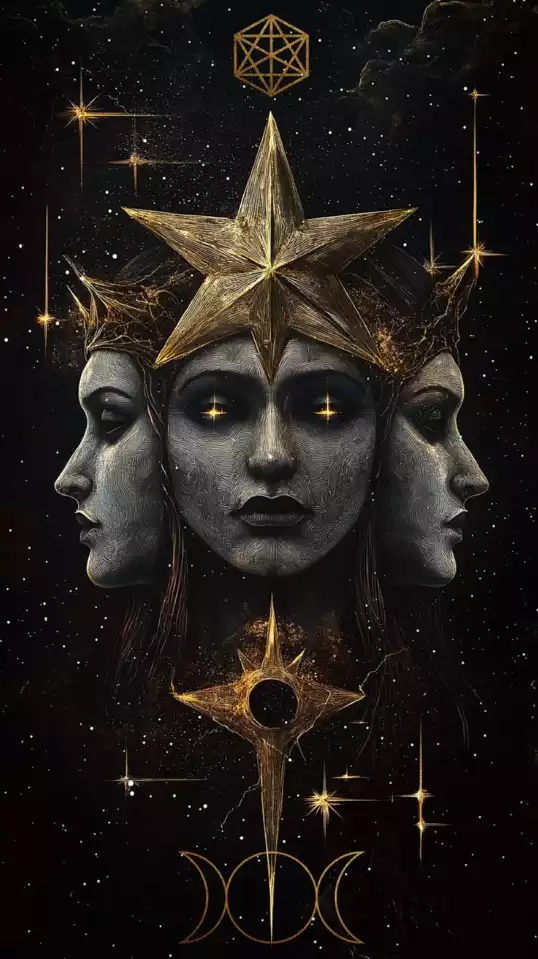
The triple goddess Hecate appears in art with three bodies or three faces, gazing simultaneously in multiple directions. This tripartite form has been interpreted variously—as maiden, mother, and crone; as guardian of sky, earth, and underworld; as the simultaneity of past, present, and future. What remains consistent is her ability to perceive what others cannot, to hold multiple realities in consciousness at once.
Hecate as the Goddess of Crossroads
The crossroads in ancient culture were not merely intersections of roads but ruptures in the ordinary fabric of space. Here, boundaries blurred. Here, offerings were left for the dead, for spirits, for gods who trafficked in transition. Crossroads symbolism saturates religious and magical practice across cultures, but Hecate's association with these sites is particularly profound.
She governs not only physical crossroads but existential ones—the moments when one identity must be relinquished for another to emerge. Initiations, whether into mystery cults or magical orders, invoke her presence. She presides over the spiritual transformation that occurs when certainty collapses and the seeker must navigate by means other than conventional knowledge.
Modern practitioners recognize in her a deity of liminal spaces—thresholds, doorways, dusk and dawn, the shore where land meets water. These in-between zones are magically potent precisely because normal rules do not fully apply. In such spaces, change accelerates. The old self cannot maintain its structure; the new self has not yet solidified. Hecate goddess of the underworld moves freely here, unbound by the constraints that limit other powers.
Offerings Traditionally Given to Hecate
Ancient Hecate offerings were left at crossroads on specific nights—particularly during the dark moon or on the thirtieth day of the lunar month. These offerings, known as Deipna Hekates, typically included:
- Garlic—protective, purifying, associated with banishing malevolent spirits
- Honey—sacred to chthonic deities, sweetening the relationship between mortal and divine
- Eggs—symbols of potential, transformation, life emerging from apparent inertness
- Wine—libation, offering of intoxication and ecstasy
- Bread and cakes—sustenance, hospitality extended to the goddess
- Incense—particularly myrrh, storax, and other resins that produce dense, lingering smoke
These offerings were not requests for favor so much as acknowledgments of her presence and power. After leaving them, the devotee would walk away without looking back, allowing spirits and stray dogs to consume what had been given. This practice emphasized the release inherent in devotion—the relinquishing of what is offered, the acceptance that some transactions occur beyond the reach of the ego's grasp.
Working with Hecate in Modern Spiritual Practice
Working with Hecate in contemporary contexts requires an understanding that she is not a cosmic vending machine dispensing favors to those who recite the correct formulas. She responds to sincerity, to genuine engagement with the difficult work of transformation. Modern practitioners establish Hecate altar spaces that incorporate her traditional symbols—keys, images of dogs or serpents, candles to represent her torches.
Hecate rituals often occur at crossroads, whether literal intersections or symbolic ones created through ritual structure. Some practitioners perform Hecate invocation during the dark moon, aligning their work with her most potent phase. Others engage in regular devotional practice—lighting candles, offering prayers, meditating on her symbols.
Honoring Hecate may involve acts of service consonant with her domains: aiding those in transition, supporting individuals navigating difficult decisions, studying herbalism or divination. Hecate devotees frequently report that her presence manifests not through dramatic visions but through synchronicities, through doors opening unexpectedly, through the sudden clarity that arrives when standing at a personal crossroads.
Praying to Hecate is less supplication than conversation. She is addressed as Propylaia, guardian of the gate; as Phosphoros, light-bearer; as Anassa Eneroi, queen of the dead. The tone is respectful but not servile. She appreciates those who approach her as sovereign beings rather than as helpless petitioners.
Common Misconceptions About Hecate
Popular culture and superficial occultism have sometimes reduced Hecate goddess of witchcraft to a Halloween caricature—a malevolent crone lurking in shadows, dispensing curses and misfortune. This characterization misunderstands the nature of chthonic deities.
While Hecate governs realms that inspire fear—death, ghosts, the unknown—she is not herself malicious. Her torch illuminates; her keys unlock. She offers Hecate protection to travelers, both literal and metaphorical. She provides Hecate guidance through transitions that would otherwise be navigated blindly.
The darkness she inhabits is not evil but necessary. It is the darkness of the womb, of the earth where seeds germinate, of the underworld where the soul undergoes purification. To work with her is to accept that growth often requires descent, that illumination emerges from willingness to confront what has been hidden.
Why Hecate Continues to Fascinate Modern Witches
The resurgence of interest in Hecate paganism and Hecate occult practices reflects contemporary hunger for models of power that do not require institutional validation. She grants authority to those who approach her directly, without priestly intermediaries. She honors knowledge acquired through experience rather than doctrine.
In modern witchcraft, she represents autonomy, particularly for women and marginalized individuals who find in her a model of sovereignty uncompromised by patriarchal structures. She does not derive her power from a male consort; she is not defined by motherhood or sexuality, though she encompasses both. She simply is—complete, self-sufficient, undiminished.
Hecate and witchcraft remain inseparable because she embodies what witchcraft, at its core, represents: the claim to power outside sanctioned channels, the willingness to walk between worlds, the courage to stand at the crossroads and choose one's own path rather than accepting the road already mapped.
Her appeal lies also in her complexity. She is not a simple archetype but a multifaceted presence whose Hecate mythology has evolved across millennia. Greek mythology Hecate differs subtly from her Hellenistic manifestations, which differ again from medieval grimoire invocations and contemporary Wiccan interpretations. Yet through all these variations, certain constants endure: her torches, her keys, her guardianship of thresholds.
The Spiritual Meaning of Hecate Today
Understanding Hecate spiritual meaning in the twenty-first century means recognizing her as a deity of necessary disruption. She presides over moments when the familiar structures dissolve—job loss, relationship endings, identity crises, initiatory experiences. These are her crossroads, and she offers not comfort but clarity, not escape but passage through.
Hecate devotion cultivates the capacity to navigate uncertainty without collapsing into paralysis or denial. It develops the interior torchlight that allows movement when external guides fail. It honors the wisdom that accumulates in darkness, in failure, in the territories that resist mapping.
Establishing a Hecate shrine or working with Hecate correspondences—colors like black and red, herbs like mugwort and belladonna, stones like obsidian and moonstone—creates focal points for this engagement. Hecate spellwork tends toward divination, protection, banishing, and workings designed to facilitate transition rather than maintain stasis.
What distinguishes authentic Hecate traditions from superficial appropriation is depth of engagement. She does not respond to dilettantism. Those who approach her casually often find nothing; those who commit to the work of transformation discover an ally of formidable power.
Conclusion: The Torchbearer's Enduring Flame
At the crossroads, in the darkness before dawn, Hecate stands as she has always stood—torch in each hand, keys at her belt, hounds circling her feet. She has outlasted empires, survived theological purges, persisted through centuries when her worship was driven underground. Today, she reemerges not as relic but as living presence, her torches as necessary now as they were when ancient travelers paused at three-way intersections to honor the goddess who guarded their passage.
Her endurance testifies to a fundamental human need: for guides through the unknown, for powers that acknowledge rather than deny the reality of darkness, for deities who stand at thresholds and say, "Here, take this light. The path ahead is yours to walk, but you need not walk it blind."
Hecate deity remains the most powerful goddess of magic because magic itself is the art of transformation, of moving between states, of claiming authority over one's own becoming. She embodies this process. To work with her is to accept that power accumulates not in security but at the edge, not in daylight but in the hours when her torches become the only illumination available.
For those willing to meet her at the crossroads—to make Hecate offerings with genuine intent, to stand in liminal spaces and ask for guidance rather than rescue—she remains what she has always been: keeper of keys, bearer of light, the goddess who opens doors that were never supposed to open and illuminates paths that were never supposed to be walked.
Her flame burns on, undimmed by centuries, undiminished by skepticism, uncompromised by those who would reduce her to symbol or metaphor. She is power itself, standing at the intersection of worlds, waiting for those brave enough to approach.
Comments
No comments yet. Be the first to share your thoughts!
Leave a Comment
Your email address won't be published. Comments are reviewed before being posted.